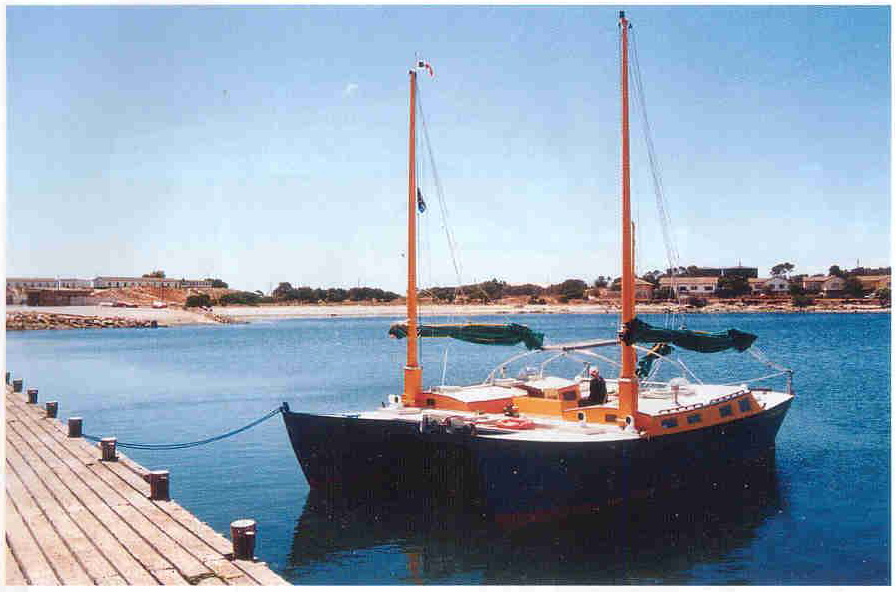
She is very easily driven and slipped along nicely with the articulating battens giving the sail a nice shape. The log was not calibrated but the estimated speed was about 3 knots to windward in a Force 3 and tacking through 100°. There was noticeable leeway, but not excessive.
As soon as the wind picked up to a Force 4 she seemed much happier with very little leeway and was doing about 5 knots. The strongest the wind got up to was the bottom of Force 5 and she was then sailing at about 6 knots and tacking through 100 – 110° with no problems. There was a firm but not excessive weather helm.
A close reach was her fastest point of sailing with speeds up to 8 knots 60° off the wind. With the wind right on the beam in a Force 4 she was sailing at 5 – 6 knots.
Both sails were pulling well but probably not at their most efficient, as the windward sail was feathered a bit and the leeward one was not in clean air. With the wind abaft the beam both sails were working well and once the wind was on the quarter she more or less steered herself. Sailing at about 4 – 5 knots in a force 3 – 4 wind the sea was flat, so of course the ride was very smooth.
The next two sails had up to Force 8 gusts, so it was not easy to analyse the performance.
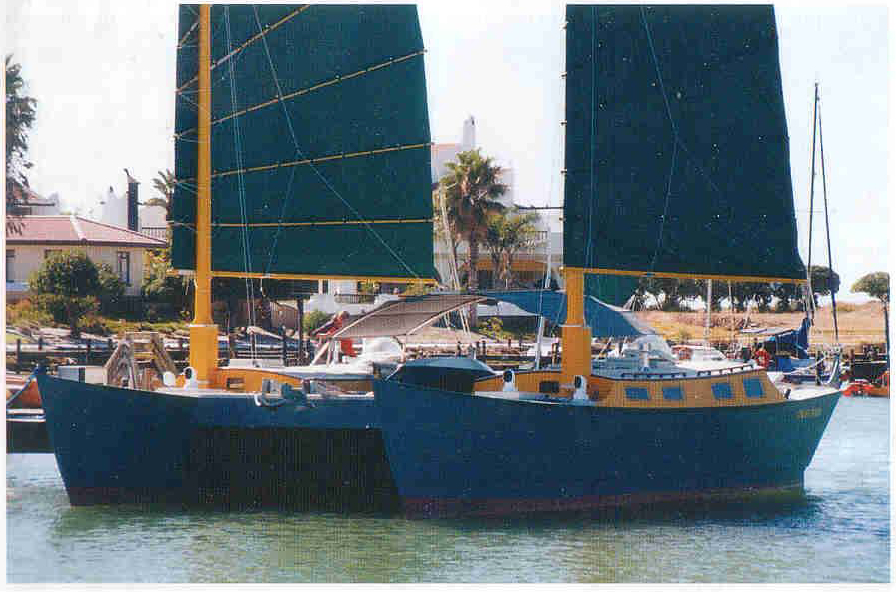
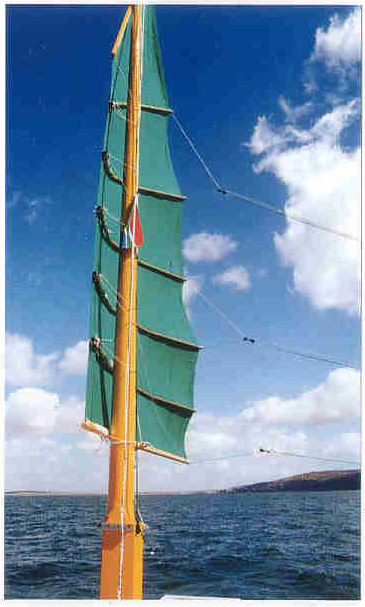
The 10 people aboard must have weighed in at over half a ton and although she seemed a bit slower it did not make that much difference. The third sail ended up with several of the bat ten joints broken and a couple of the batten tubes bent, as well as flaring of the tubes ends at the joints, so obviously the battens were too weak. I was loath to give up the articulating battens as they give the sail such a good shape and I am sure that a flat sail would ruin China Moon’s windward performance. I have now made carbon fibre battens using the old alloy 38mm OD x 1.6 mm wall tubes. My original joints were of white oak with a 3° taper on each of the cone ends. I have made the new external joints out of 50mm OD x 3mm wall plastic pipe with a heavy layup of unidirectional carbon and plenty of glass and carbon going around the tube, it was not a cheap arrangement, but with 18’ long
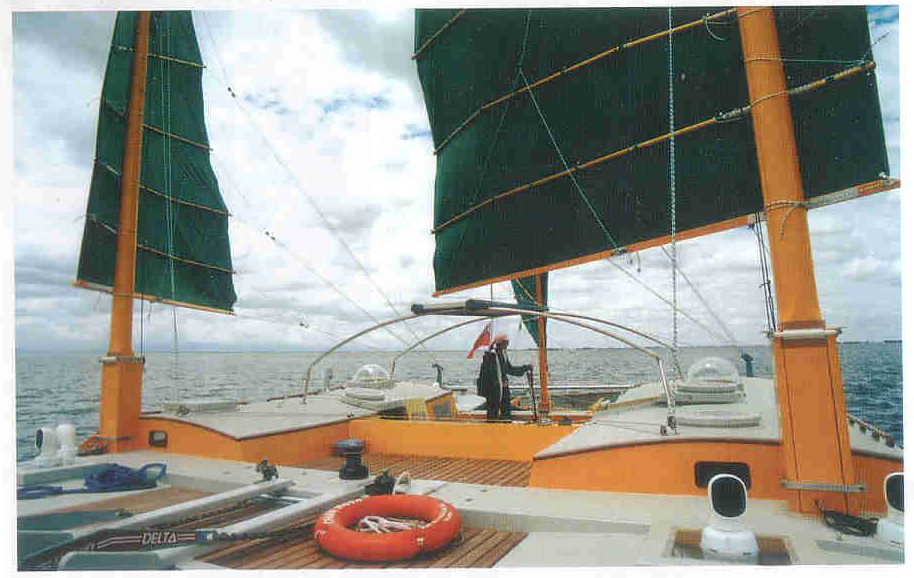
The 26’ masts are hollow Douglas Fir and 8” OD at the partners. They are quite stiff and there seems to be little bend. They are mounted in tabernacles and quite easy to lift up, using the big rope winch on the centre deck.
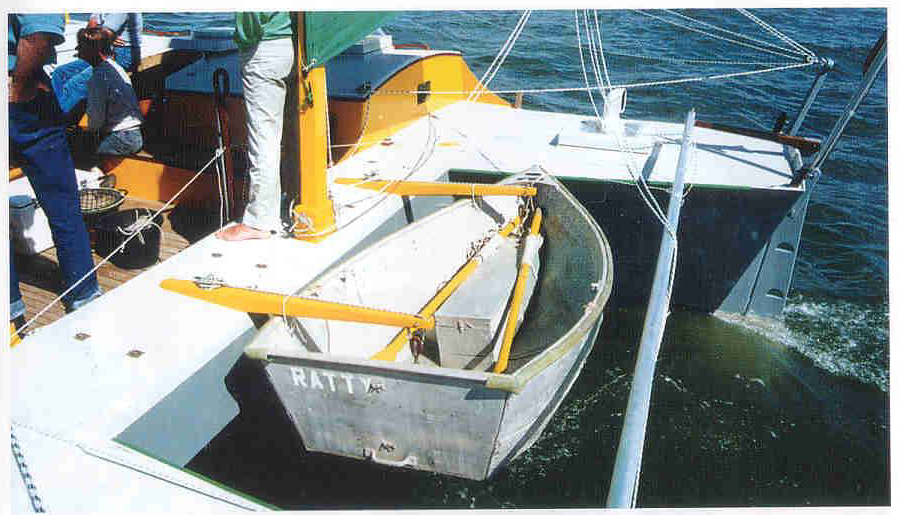
China Moon swallowed 10 people sailing her without being the least bit crowded.
The engine in the one hull works fine and she is very easy to steer going ahead, although going astern and manoeuvring in a marina is very difficult, especially if there is any wind, but with a 23’ beam I could never afford a marina again.
The plan is to finish the essentials such as the self steering gear and a bit of electricity, then sail to Brazil via St Helena and spend several months in Brazil finishing China Moon off, before heading south to Argentina.
If any other members are planning on putting a junk rig on a cat then I hope they will be encouraged by my efforts — it does seem to work. I would say that two important aspects are keeping the masts well apart. (The centre of each mast is 18’8” apart) and having some shape in the sail.
Progress Report December 2003
China Moon made a good passage to Brazil via St. Helena and later headed south to Patagonia, but it was decided not to continue to the South Shetlands as originally planned until the self steering is working better, so we are headed north back to Jacare in Brazil.
On passage we broke new ground by going up the Rio Negro to Viedma and were told that we were the first yacht that anyone could remember having paid them a visit.
Apart from some small problems China Moon is proving herself to be a very able vessel. I am still learning how to get the best out of her. She sails very well to windward, a bit sluggish in a Force 2 but once the wind gets to a Force 3 she starts to move. The stronger the wind the better she goes. In a Force 4 – 5 she will be doing 5.5 to 6 knots and tacks through 100° (in a smooth sea) and 6 to 7 knots in a Force 6, there is little leeway. She sails much better to windward than I had expected. I’m sure the articulating battens account for much of this. The carbon fibre battens are holding up well with no sign yet that they will break, and we have been out in some quite strong winds. There is some interference between the sails on a reach but it is not a problem as it’s a fast point of sailing anyway. Downwind China Moon is a dream with the sails “wing & wong” she will steer herself.