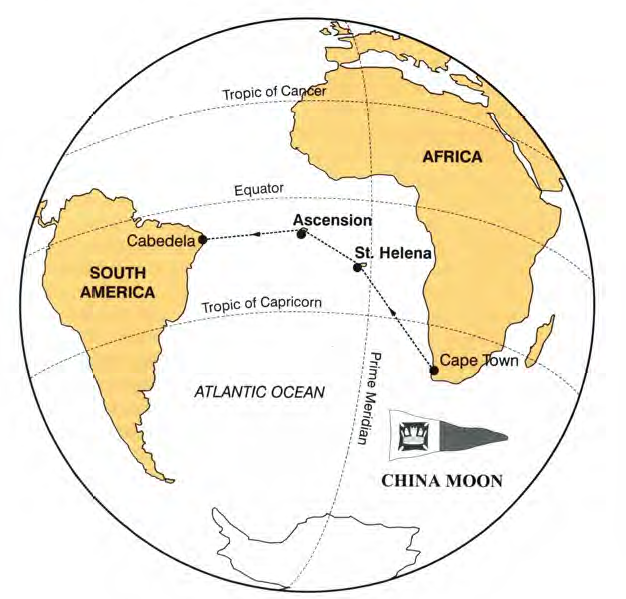
I can’t honestly say that China Moon was in all respects ready for sea but, after three years building her in South Africa, it was time to leave, a view the lenient immigration authorities wholeheartedly agreed with.
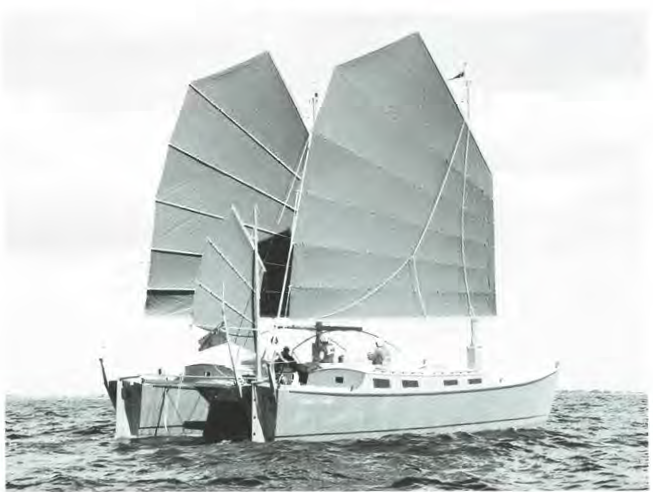
The idea for China Moon first germinated after reading about Dragon Wings, a 34ft catamaran with a junk rig on each hull, in the Junk Rig Association (the nautical equivalent of the Flat Earth Society) newsletter. Combining the best cruising rig with a catamaran was an intriguing idea. The design that evolved was meant to be suitable for high latitude cruising and, hopefully, seaworthy enough to cope with the conditions there. A junk rigged plywood catamaran would not generally be regarded as an appropriate vessel and so it was a bit of an experiment. “A rather expensive experiment,” a friend of mine dryly commented.
Early in March China Moon set out from St Helena Bay, north of Cape Town, towards St Helena Island and, owing to a change in my domestic arrangements, I was sailing single-handed. Leaving at the same time was Speedwell of Hong Kong, a teak Vertue, also sailed single-handed by my friend Shirley Carter. Port Owen Yacht Club gave us a friendly send off and after they had escorted us off the premises we sailed to nearby Stompneus Bay to finish the stowing and last minute jobs in peace and quiet.
On leaving there was a fresh southerly but by nightfall this had veered to the south-west and it started to blow hard, force 7-8. The wind was just abaft the beam and once the waves built up they started to find the deficiencies in my stowage. Each time a wave crashed into the side 50 tins of pilchards hurled themselves onto the cabin sole. By the time the cutlerydrawer had crashed to the floor I’d had enough and soon all the cupboard doors and drawers had been firmly closed with duct tape. China Moon was well snugged down with just the top panel of the windward sail up, but she still averaged seven knots overnight.
By the next evening the wind had moderated and backed to the south- east and there it stayed for the rest of the passage. I had no problems with loneliness but by far the hardest part of single-handed sailing is the drudgery of waking every 20 minutes for a look out. Navigation was by sextant and, to add to the sport, the log was on the blink. I had allowed for this eventuality and bought an Autonic trailing log, but that was at the manufacturers being repaired, even though it was new. On the approach to St Helena the island was lost in the haze and just when I was about to heave to that night, having guessed I had run far enough, I spotted some lights ashore and sailed on. At breakfast time I anchored off Jamestown, 11 days out. Speedwell arrived later that week having had a very wet time of it in the gale and losing the wind for a few days.
Six weeks were spent at St Helena, mostly working on the unfinished interior of China Moon. However time was taken off to enjoy many of the lovely walks the island has to offer. At sea level the island is a desert but the upper plateau, which catches the trade wind clouds, is lush and green. Country lanes and footpaths wind all over the island and it’s like stepping back in time to a rural England. Flax used to be the main industry, with the entire crop going to supply the GPO with string When the post office went over to synthetic, the flax industry collapsed overnight. Much of the flax still remains, but it is now a weed and extremely hard to eradicate. Times are about to change on the island, as a British consortium is going to build an airstrip, hotel and golf course. St Helena’s days as a remote colonial outpost are numbered.
700 miles downwind of St Helena is Ascension Island and the passage there proved to be perfect trade wind sailing. Once anchored, getting ashore is quite precarious. The landing place is a small stone jetty that has hardly changed from the picture in Eric Hiscock’s Around the world in Wanderer III. There’s a constant swell and you have to jump out at the top of the wave, grabbing one of the ropes provided. The dinghy has then to be tethered to one of the long small craft mooring lines, while the water swirls around your feet. If it’s a day of the Rollers then you don’t land.
Ashore the scenery is an impressive volcanic landscape and the island is littered with perfect cones and hardly any vegetation. The exception is Green Mountain and a walk to the summit, passing through the now abandoned farm, takes you to a different world. It was near the end of the green turtle breeding season but at night we were able to see several turtles laying their eggs in the sand and, by day, there was the odd hatchling scampering for the sea.
The airfield on the island refuels the twice-weekly Falkland Islands flight and, knowing that mail is dropped off, I had arranged to have my post sent there in good time. It had not arrived and after waiting for one more flight I gave it up for lost.
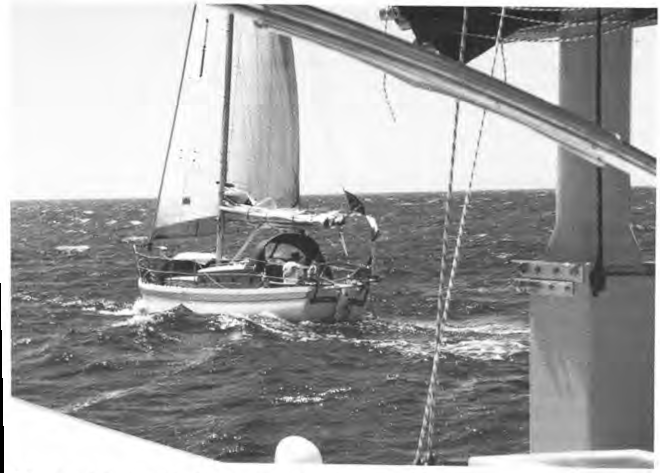
Speedwell had left the day before me but China Moon was sailing at her best in the fresh south-easterly and on the second night out I spotted a white light ahead. It could only be Shirley, so I altered course a little and slowly caught her up. As I passed we exchanged salutations by shining a torch on our sails. The other incident on the passage was when the self-steering got wiped out by an unexpected gybe. It was the middle of the night, of course, and after recovering the pieces it seemed prudent to wait till the morning to try and repair it. Not wishing to steer or slow down I set the sails ’wing and wong’ and let her steer herself, which she did quite well until I fixed the wind vane next morning.
A week out from Ascension I arrived off Cabedelo in Brazil, having averaged over seven knots for the passage, and then went to anchor at the village of Jacare. Speedwell arrived a few days later, tacking up the river as the sun was setting. Ravel’s Bolero was playing at one of the bars ashore, a sunset tradition going back 20 years.
Postscript: A couple of weeks later my lost mail was delivered. It had been sent to St Helena in error, where an Australian spotted it, and knowing I had already left for Brazil, took it to Salvador. Via a Swedish HAM net he found out I was in Jacare and sent it on a Belgian yacht going that way.
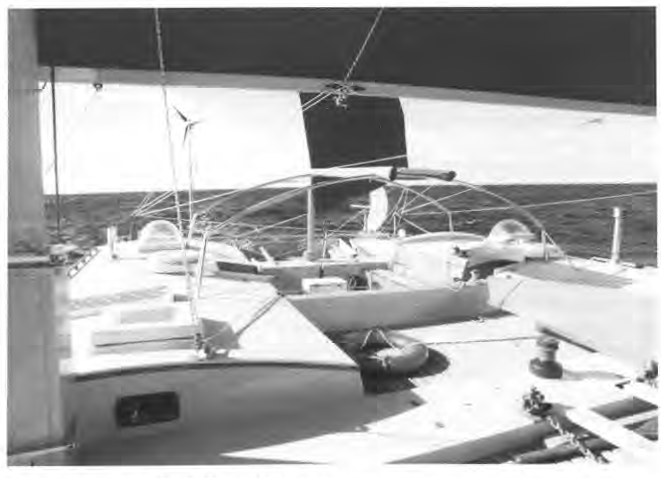
China Moon is 38ft x 23ft x 3ft, with an open bridge deck and accommodation in each hull. The dory shaped hulls have transom-hung rudders
The unstayed masts are held in tabernacles and support a fully-battened rig of 360 square feet. A 27hp Yanmar sail-drive is located in the starboard hull. The hulls are fully insulated with double-glazed hatches and windows. Self-steering is by wind vane driving a trim tab on the port rudder.