

Written by Ewen Southby-Tailyour
Ten entries in the inaugural Jester Challenge for single-handed yachts under 30 feet departed Plymouth at 1200 BST on 3 June 2006 and headed towards Newport, RI. The first to arrive, a Frenchman, did so after 31 days 15 hours 35 minutes and the second (and last), Pete Hill, crossed the line after 44 days 6 hours 56 minutes. That basic statistic might not indicate success to some, but to me and all the participants it was a huge vindication of our efforts.
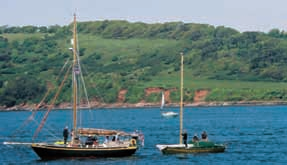
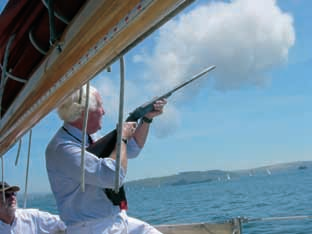
In 1960, Blondie Hasler’s ‘amazing idea’ was sailed by five yachts, four of which were less than 30 feet. Navigation was traditional, self-steering was experimental, and all vessels crossed the north Atlantic in good order. However, by 1968 Blondie was becoming worried that the success of his race contained the seeds of its own death, with excessive competitiveness one of the reasons cited.
Fearing its demise, he drew up plans for a Series Two race that, if necessary, would begin in 1980
with…no sponsor nor organising club…nobody the nannies can snipe at except the competitors themselves… ordinary yachtsmen going about their (legal) business…making an independent passage on (their) own responsibility…no rules…no entrance fees…any skipper who is unable to remain alive by his own efforts is expected to die with dignity…treating (the skippers) as adults who can…take their own risks….
The Series Two never took place, but events were beginning to suggest that something similar was overdue as the Royal Western Yacht Club’s trans-Atlantic race was now swamped by professional entrants using it to qualify for other professional races. To return to something resembling the original, the club was obliged to hive off the professional element of the OSTAR (to use the name most associated with the event) to Offshore Challenges, so it could revert to running a Corinthian event while maintaining the lower limit of 30 feet.
This restriction had been introduced in earlier races, partly for administrative reasons but primarily as a result of new stability requirements which, although not banning the smaller vessels, made it very difficult for them to comply. Nevertheless, the result, whether intended or not, led directly to the exclusion of patently seaworthy yachts from a race that had had at its heart the 25-foot Jester herself. This would come as a surprise to owners of, for example, the Twister, Folkboat, Contessa 26 or, even, the diminutive Corribbee 21. Experienced seafarers believe that there is more to safety at sea than size and the righting-moment of a displacement hull. They know it is a matrix of numerous human and physical factors.
Every skipper in the Jester Challenge owned his own vessel and had invested significant savings in her (in some cases, she was the skipper’s home). I hoped this would ensure that, unlike modern almost expendable ocean racers, these smaller yachts, precious personal possessions, would be cosseted and nurtured.
Part of the beauty was that there were no back-up teams supplying navigational, meteorological and medical help, and there was no time limit. Without inspections and rules, the challengers sailed against each other on an individual basis. I told the skippers I didn’t expect them to give a fig about level playing fields, only that they were required to behave like gentlemen over the number of people on board, use of an engine and so on. They would be happy, I trusted, to reach the other side safely and then compare notes on navigation, food, routes, clothing, gear, rig, sail plan and so on.
Some people suggested that I insisted on oil lamps, towed logs, sextants and lead-lines, but they missed the point. While the Jester Challenge may have been for small boats, some of which would have been built in pre- GPS days, there was nothing Luddite about it. With no rules, they could carry (or not carry) what they liked. GPS was favoured while, conversely, wind vanes rather than mechanical steering systems predominated.
The Jester Challenge was a modern experiment in old-fashioned self- reliance, self-sufficiency and personal responsibility. It replaced no existing race and was complementary to the RWYC’s OSTAR. Now, by popular demand, I am developing more events beginning with the Jester Azores Challenge in 2008, followed by a repeat of the trans-Atlantic Challenge in 2010 – the fiftieth anniversary of Blondie’s first race.