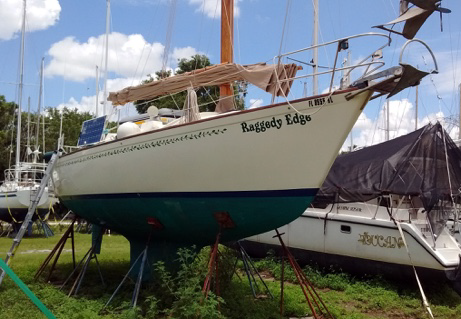
Oryx was up for sale and my New Zealand visa was about to expire so I needed to find a new home. An internet search for junk-rigged boats for sale brought up Raggedy Edge, a Pearson 367 lying in Florida. She appeared to be in good condition, was a suitable size, had lots of equipment, and was very reasonably priced at $8,000 US. I bought her sight unseen and booked my ticket to Florida.
I flew to Orlando via Honolulu and New York. The airline had allowed me a very generous two items of luggage of 30 kgs each, not to mention 10kg of cabin luggage. I took full advantage of this and nearly killed myself trying to get it to the airport on the bus. On arrival at Orlando I went to pick up the car I had booked to drive the 100 miles to Indian Town, where my new boat lay. Unfortunately I hadn’t realised that I needed a credit card to hire the car, they ‘let me have it with just a debit card. Bus transport was out and Uber were not interested in driving me. In desperation I telephoned Mark and Tina, Raggedy Edge’s owners, who were staying in their motor home near Indian Town to hand over the boat to me. They very kindly agreed to drive to Orlando to pick me up and then put me up for several days, very generous hosts.
The next day I saw my new boat, which I have renamed Blossom, and was pleased to see that she was as advertised. We did all the paperwork, Mark and Tina then drove me around to buy what I needed and when the boatyard relaunched her a few days later I moved onboard. It was the middle of May.
My original plan was to sail Blossom up to the Chesapeake Bay, out of the hurricane belt, and make some modifications there. Instead I decided to sail back to the UK to do the work there. To avoid hurricane season I needed to get going quickly.
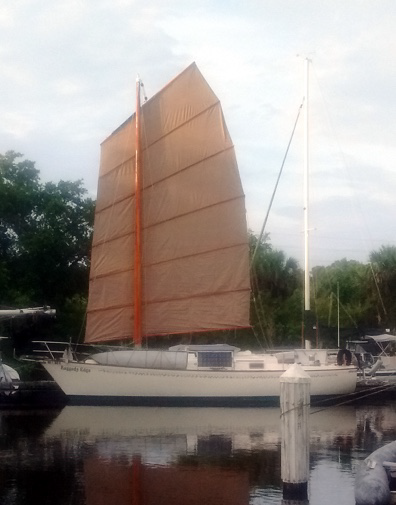
Blossom had been converted to junk rig by the owners prior to Mark and Tina. She had a nice hollow wooden mast and a well made flat sail, but the sail was really too tall for the mast height and the battens looked far too light. I spent two weeks sorting the boat out, strengthening the battens and buying extra wood for repairs, amid much rain and thunderstorms as the first tropical storm passed in the Gulf of Mexico.
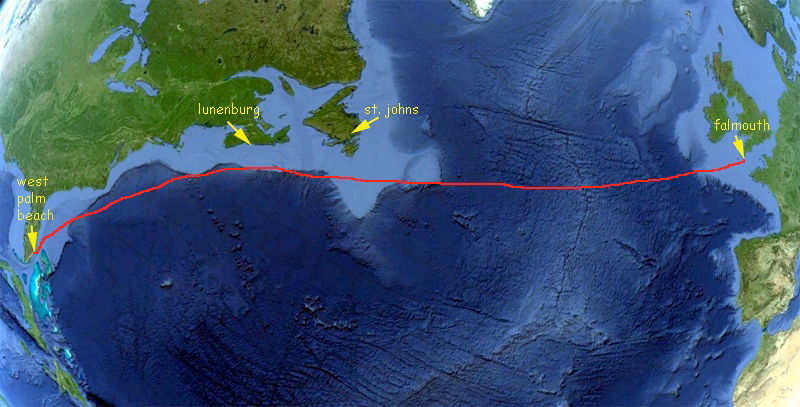
I left Indian Town Marina on 29 May and motored down the St. Lucie canal to Stuart, on the east coast. Blossom’s original 40hp diesel had been taken out some time ago and been replaced with a 6hp outboard on the stern. It worked well in flat water, but cavitated badly with every power boat wash, and there are a lot of power boats in Florida. The next day. I went for the first sail in the wide bay off Stuart. Blossom sailed very well despite needing one reef, because of the too short mast, and rather too much lee helm. She pointed quite high and tacked reliably and I was very pleased. I continued motoring down the Intracoastal waterway, passing countless Italianate palaces, most with big power boats tied up to their docks, a mind boggling ostentatious display of wealth. It took two days to get down to West Palm Beach, where there is access to the sea. I quickly cleared customs and did a final stocking up of fresh food. On 2 June I motored out of the breakwaters and set sail towards Falmouth.
The wind was a light south-easterly and we drifted and sailed slowly north, helped enormously by the Gulf Stream. The next day the wind veered to the south west and picked up to F4, giving a very respectable run of 136 miles. This was followed by more light winds and calms, but glorious sunshine. I was sailing very conservatively as I was concerned about the strength of the battens. Ideally I would have built new battens but time was against me and I already had plans to redesign the rig as an Aero Junk.
On day 9, in a southerly F5 the second batten down from the top broke. I reefed right down and waited for the wind to moderate to repair it. One of the great things about Blossom was that she came equipped with a Monitor self steering gear, which steered her beautifully. Rather than being tied to the wheel I spent my days planning her new rig and the small changes I wanted to do, as well as catching up on my reading.
We seemed to have sailed out of the Gulf Stream, and at times even had a counter current. The wind went up and down, but there were no really strong winds and quite a few calms. On day 13 (lucky for some) the next batten broke, on day 16 the boom broke, snatching in the swell and light winds. It seemed prudent to head for Lunenburg, in Nova Scotia, 200 miles to the north of us and do something about the boom and battens. But the wind disappeared and, now back in the Gulf Stream, we were carried quickly to the east. Then the wind picked up and the top two battens broke. We were making very little progress towards Lunenburg and I decided it would be easier to head for St. Johns, Newfoundland.
The wind and seas had dropped enough to get the sail off and repair the boom and broken battens. Before I could finish, the wind got up again and I sailed under bare poles with the self steering. On day 24 (26 June) I managed to get the sail reassembled on deck with some difficulty, but it was too rough to re-rig it on the mast and so I lashed it down on the starboard side deck. The wind then quickly picked up to a westerly F7. We had been lying ahull whilst I worked on the sail, but the seas were building and I started hand steering downwind under just the windage of the mast. I thought the self steering would cope, with occasional help when a wave hit the stern. This was working well, but it was getting colder. I nipped down below to put some warmer clothes on for what I thought would be a long night.
I had barely started to don the clothes when we were hit by a big breaking wave, which seemed to come out of nowhere (until then there had been no dangerous seas), that knocked us down onto our beam ends. Blossom quickly recovered, but a lot of water had come below and the cockpit was full. I quickly put my waterproofs back on and went out to a scene of destruction. The sail bundle was all but washed overboard, two stanchions had ripped out of the deck, the pulpit was broken and twisted and both solar panels on the starboard side were washed away.
Thankfully another piece of Blossom’s equipment was a Jordan series drogue, I had already rigged it, ready to go, and it was quickly streamed astern and this rapidly brought the stern into the wind and waves, quietening everything down. With great difficulty I managed to get the sail bundle back on deck but, of course, the repaired boom and battens were again broken. Down below I pumped out, but everything was wet: a horrible night. I was very despondent and feeling depressed.
Later that night we got hit by another breaking wave astern, which filled the cockpit and sent a few gallons below through the cockpit lockers, but there appeared to be no damage done: the drogue was doing its job. The next morning I discovered that the wave had somehow displaced the bevel gears on the self steering, it was inoperable unless I could repair it.
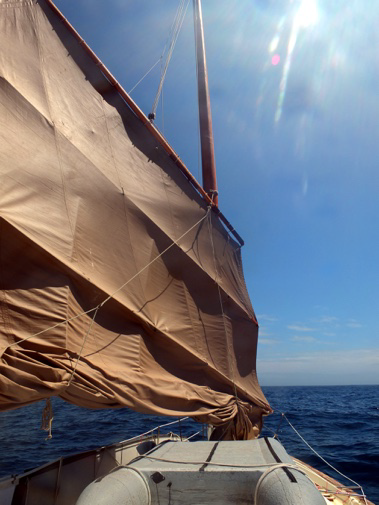
When the wind and seas went down I started trying to get the rig back together. I had run out of wood to repair all the battens but was able to splint the boom and repair the top two battens. When I had taken the sail off the mast earlier I had tied off the topping lifts to either guard rail, when the starboard guard rail got flattened it had broken the starboard topping lift rope close to the masthead. I re-rove it using the spare masthead block and was able to hoist three panels of the sail. Steering was now by hand which gave me plenty of time to think about how I could possibly repair the self steering without bringing the whole contraption on deck. The thought of steering for 2,000 miles certainly concentrated the mind and before long I was leaning over the stern and fiddling with tiny circlips to release one of the bevel gears and realign it. It worked and I didn’t lose a single part so we were back under self steering again, what a relief.
The next disaster was the shackle on the spare mast head block failing. Now I had only the port topping lift with the reefed part of the sail on deck. The solution was to rig up a block on a rolling hitch on the mast and push it up as far as I could with the boat hook, fortunately high enough to allow two and a half panels to be raised.
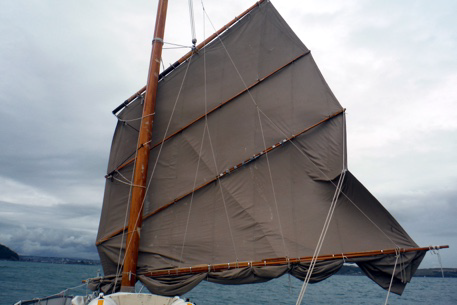
By now I had given up on the idea of going to St. Johns, 400 miles to the north. By the time I got there and sorted out the rig I would probably be almost to the UK if I just carried on. The other option was to go to the Azores, but again that would require a big detour to the south, and it may well have caused problems with VAT, I much preferred to pay VAT in the UK, especially with Brexit about to happen.
On the 1 July in very light wind and thick fog I saw a big yacht, CR 29, coming up astern on the AIS, I was doing about 1 knot, they were doing 11 knots! They actually had to alter course a little to avoid me. I spoke to them on VHF and they kindly agreed to send an email to Linda, who was eagerly awaiting my arrival, explaining about Blossom’s damage and my extended passage time, which was quite a relief.
We continued east with fine weather and the wind much too light for the reduced rig. I was not going to run out of food but I now started to ration it more carefully to be on the safe side. Fortunately there were no more problems with the rig and it was very pleasant sailing, largely in sunshine.
On the 52nd day at sea, after 3,883 miles, I anchored in the evening in Falmouth Harbour. It was the 24 July, just in time to wish Linda a happy birthday and report my long overdue arrival. A couple of days later I sailed around to the Tamar river and Blossom was hauled out at South Down Marina to start the repairs.
Blossom had looked after me well and with a new rig she will make a fine cruising boat.