

How did it all start?
Raivavae (Austral Island – French Polynesia)
Like in a dream, over the calm turquoise seas of the tropical lagoon, Pete effortlessly rowed us out of Raivavae harbour in Crake (7ft Bolger Nymph). It took us about ½ hour to get to one of the most beautiful tiny tropical motu I’ve ever seen.
By the time we wanted to row back to the village, the wind picked up a lot. The long row back, into a strong headwind, was a different story. Pete was really struggling to make any progress while I was sitting there, a dead weight. It frustrated and worried me a lot. I wanted to, but could not help. Being inexhaustible, he rowed for hours, and we eventually made it safely back. I was grateful but remained worried. I did not want a similar situation to be repeated with an unhappy ending.
Tonga
We went exploring close to one of the reefs in Crake, with our guest, Roger. Having spent some time wandering around, we noticed dark clouds gathering. We made a quick dash to get to the dinghy, and then the race with the clouds started. They were dark and low, looking very threatening. The dinghy was quite loaded with three of us onboard, and only Pete was rowing, making slow progress. It did not look good. I realised that I could help him by hanging off the stern, the flippers on my feet propelling us forward. It was exhausting, and it went on for ages, but I did not give up. After this, my back was complaining for a while!
Having had those two experiences, I demanded (!?) that Pete finds a solution for me to contribute with dinghy propulsion.
Analysis
| We Need to Have | We Don’t Want |
| Dinghy A light, easy-to-carry and lift aboard Rows well Simple to repair and inexpensive to replace | Inflatable They are heavy, don’t row easily, can be punctured, one gets wet sitting on tubes, are expensive with a relatively short life and are often the target for thieves. |
| Propulsion Problem-free simple propulsion Oars – not dependent on complicated mechanics or technology to get it repaired or working. “If it is obsolete it works!“ | Outboard Petrol – they are noisy, smelly, heavy, need one more fuel type (and a dangerous one), plus are expensive, create pollution, require maintenance, are target for thieves Electric – very expensive, heavy, reliant on limited recharging capacity onboard, lengthy recharging time |
| Propulsion | Advantages | Disadvantages |
| Oars | Relatively inexpensive to buy Relatively easy to make DIY Cheap to make Long lasting Light Not a target for thieves | Not as powerful as an outboard motor Easily lost if careless Two people can’t row easily a small dinghy |
| Sailing Rig | Quite powerful and good fun | Complicated to build DIY Expensive to buy Difficult to stow Time consuming to assemble into the dinghy Wind dependant Usually not onboard when needed Not so practical when carrying load or people |
| Power Fin Sculling | Same as the oars + Both people can propel Sculler facing forward: navigates and steers The pole is very easy to lift in and out | Fin significantly increases the draught – but can easily be lifted out of the water If used on its own: The dinghy can’t be stopped Is less manoeuvrable when coming alongside Can’t go in reverse |
One of the problems with the size of a dinghy that fits on a normal cruising boat is that it is too small to be able to use two people rowing. Our 9ft/2.7m dinghy is a size bigger than the average 8ft hard dinghy on most boats. Two people rowing in tandem would depress the bow too much to be effective or safe. It would probably need a 10ft/3m or bigger dinghy to accommodate two rowers in tandem. Not only would this be too large to stow on the deck of most boats, but also too heavy to be convenient to lift on board or carry up the beach.
It was important to be light, maintenance-free, of a reasonable size, and row well. After prolonged deliberation, we were offered the use of Chris Rees design 9ft dinghy, fibreglass mould.
- No gelcoat to keep it lighter
- 2 layers of 300gsm and 1 layer of 450gsm
- pigmented polyester resin
- Built-in buoyancy bow and stern.
- Two rowing positions plus fin sculling
Pondering a possible solution, Pete toyed with the idea of a Hobie Mirage Drive fitted into the dinghy; however, this was complicated to fit and expensive, almost the cost of an outboard motor. Pete eventually came across a YouTube video by Atsushi Doi, a Japanese man who had developed a power fin sculling. It looked to be just what we needed. There were no plans available, so Pete just designed something that could work.

What is Power Fin Sculling?
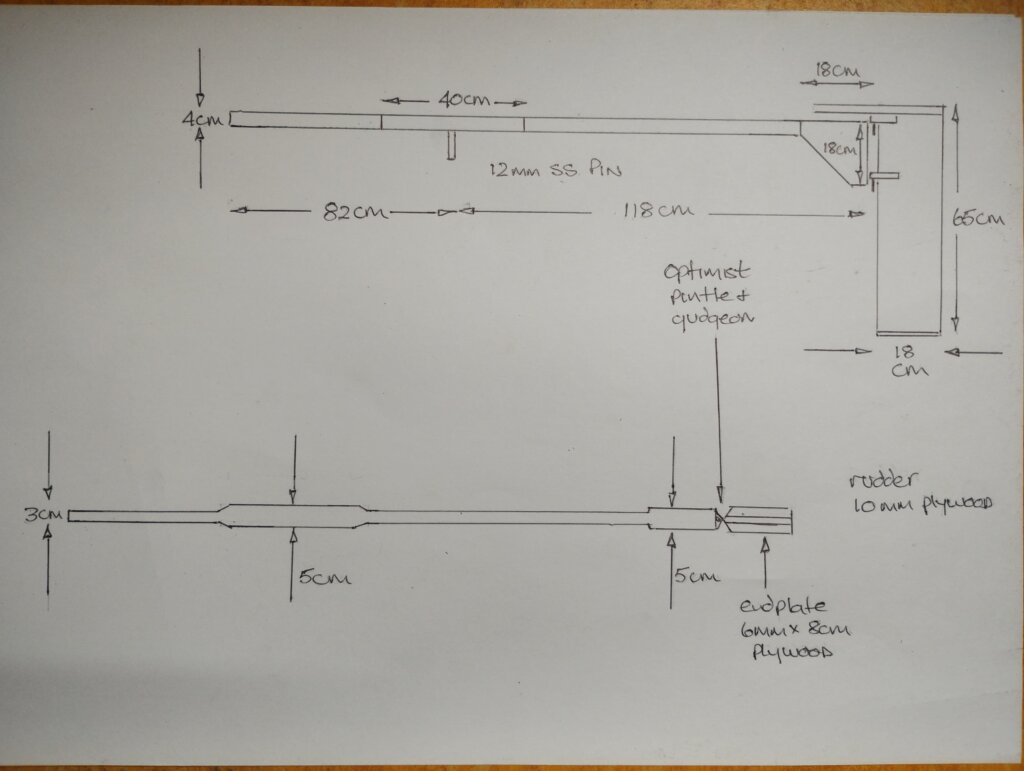
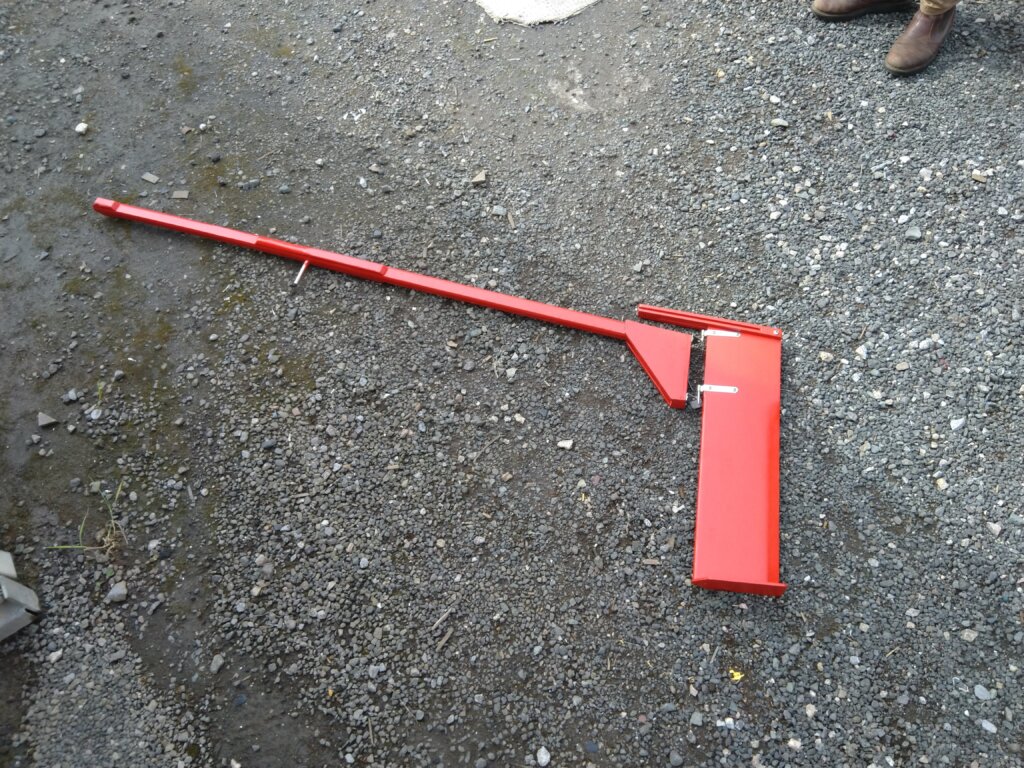
- It is a vertical, reasonably high aspect ratio rudder hinged vertically on the end of a 6ft pole ( in our case).
- The pole has a vertical pin about halfway along its length which fits into a suitable hole on a transom of the dinghy (in our case 12mm stainless steel round bar).
- The rudder has a short tiller with a light line going to the pole to limit its travel from side to side.
It works by moving the forward end of the pole backwards and forwards. As the rudder flips from side to side it produces forward motion. On its own, it can be used to propel the dinghy at similar speeds to sculling with an oar over the stern but with the big advantage of being very much simpler to operate. In our experience on its own, it does not give the same power as rowing with a pair of oars in the normal way. However, we can now row with a pair of oars from the forward rowing position. The other person in the dinghy can work the fin sculling pole. This greatly increases our speed, particularly rowing against strong headwinds, when it is the most needed. Another advantage is that the fin sculler is facing forward and can steer with that rudder. It requires no skill to operate (unlike rowing or sailing).
The main disadvantage of the sculling, if used on its own, is that the dinghy can’t be stopped and is less manoeuvrable when coming alongside than a pair or oars. Another disadvantage is that the vertical rudder significantly increases the draught and so is not suitable in very shallow waters but it is very easy to lift the rudder clear of the water.
Conclusion
It works very well, we are super happy with it. Linda is now the human outboard – sustainable, reliable, beautiful but high maintenance! It draws a lot of attention. So we thought it would be good to share it here.
The drawing represents the dimensions we used and it works very well on our 9 ft fibreglass dinghy.
The YouTube for the Japanese video:
https://junkrigventures.org/wp-admin/post.php?post=2062&action=edit