

Over optimistically, I thought we could finish Kokachin in about a year, it took us three years with the two of us working full time (weekends included).
Very soon, as we started working on her, we realised that Le Forestiere’s Jonque de Plaisance are complicated boats! Also if she was to meet our needs and wants many things would have to be altered and finished differently. All of this was going to take time. It was not a quick job any more, as it looked at the time of infatuation, read – decision to buy her. Both of us wanted to spend time sailing instead of boat building. But does one ever learn.
Daily hard and long hours of work was followed by household chores and researching / ordering the material. Covid worked in our favour, we had a committing project to complete. Just before the lockdown Pete spent three whole days ordering everything we would need for the boat building. All the material had to be stored either inside or outside the boat on which we were now living. The biggest nightmare was finding a place to store things, and having to move them around all the time. I spent frustrating hours searching for something which had been moved (who knows where) but we needed it there and then. After the first year Blossom was sold and we moved onboard. While this sounds like a living hell (and probably was), it was much better than living on Blossom, for many practical reasons. Kokachin was warm and cosy, although cramped. Often we asked ourselves: “Why on earth did we embark on this madness yet again?” While laughing at her bizarre shape I dreamt of the day when I would sail her. Most of this hard work would be forgotten by then.
It took three years from the boat arriving in Southdown until launch day, working 7 days a week, 10 hours a day, two of us for over two years. On the last year we allowed ourselves Sundays off. For the original build Mr Fabrice took 7 years, but part time. Our workshop was a shed constructed over the cockpit, and to everyone’s amazement, not least ours, it survived for three winters of gales. The materials were stored under the boat, inside it or in the shed.
We are often asked: Has she met our expectations? Actually when we bought her we had no expectations or dreams. We wanted to try something different and she has definitely surprised us – by how well she sails and how comfortable she is at sea in rough conditions down below, we never strap up in the galley and we don’t have lee cloths. While she can roll a bit when sailing down wind or in a rolly anchorage, she heels little and does not slam. She is fun to sail and is surprisingly manoeuvrable despite her long keel and 13 tons displacement. However Linda struggles with the big, heavy rig on her own and finds that the lovely spacious cockpit in harbour becomes very exposed at sea when the going gets rough.
To see more about her sails and spars see other Kokachin’s pages on her webisite and the rest of the blog post that followed.

Finally Kokachin was launched. She sails well, easily driven and fast. Sailing to windward she tacks through 90 degrees in flat waters and goes about easily, especially when centreboard is down, even in big seas she tacks very well. It is often difficult to assess sailing performance, especially to windward, as there is not another boat to compare against, Recently we sailed in company with friends on a Nicholson 32. They sailed the boat well and had a nice suit of sails. The course was dead to windward for 11 miles, wind 20 to 25 knots and a very rough sea. We were pointing equally well, tacking through about 100 degrees, and making 10 degrees of leeway. The Nicholson was a bit faster, but not by much. We were impressed and so were they. Kokachin is very stiff and even driving to windward she heels no more than 15 degrees. She is spectacularly dry in the cockpit, while we only had a couple of small splashes on the above sail, our friends were drenched. Sailing downwind she doesn’t roll until the wind and seas build up, but by then the foresail will have been reefed and sheeted flat, which dampens the rolling to a certain extent. Because of our vulnerable self steering gybing requires sheeting the main in and then out on the other side and in strong wind this may include dropping a few reefs first.
On the downside we found that the tiller steered rudder was very heavy work especially as the wind got up. As Kevin Cardiff said: “Not a problem, but a design characteristic”. So far we have tried to tame the heavy steering with a three part handy billy, using the trim-tab to dial out any weather helm and finally steering with the trim-tab. We now cut a chunk at the lower part of the rudder. We need to wait for sea trials to see how effective that is going to be to reduce a heavy helm. These are only partial solutions and we may well have to resort to wheel steering, which would be a disappointment. But at times, in rough seas the tiller becomes almost uncontrollable.
Self steering is a very important consideration on long passages. From the outset the self steering was going to be a challenge! Self steering is with Bill Belcher OTG II wind-vane driving a 20% trim tab on the trailing edge of the rudder. We also found that in lighter winds the wind-vane (3′ x 1′ / 90cm x 30cm) was not powerful enough to turn a trim-tab. This was a major setback. Kokachin’s rig extends the whole length of the hull and the main sail is sheeted to the aft end of the davits. The wind-vane is placed on the stern rail, inside the main sheet. There was no room to make the windvane bigger so the only solution seemed to be to make the trim-tab balanced. This necessitated a quick haul out and moving the trim-tab somewhere behind the rudder with 20% balance. This solved the self-steering problem and it now works very well. However the wind-vane is very vulnerable to being swept away by the main sheet (which has happened on our Channel and Atlantic crossing, resulting in a broken wind-vane). We now have installed a strong hoop over the stern rail to give it more protection. We need to see how this will work.
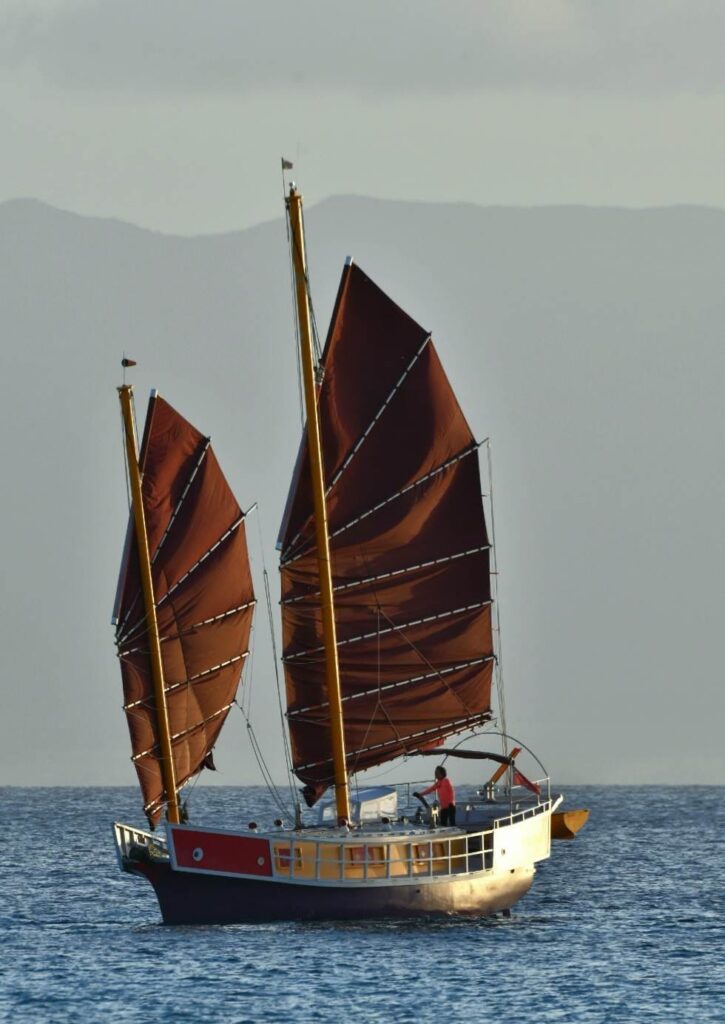
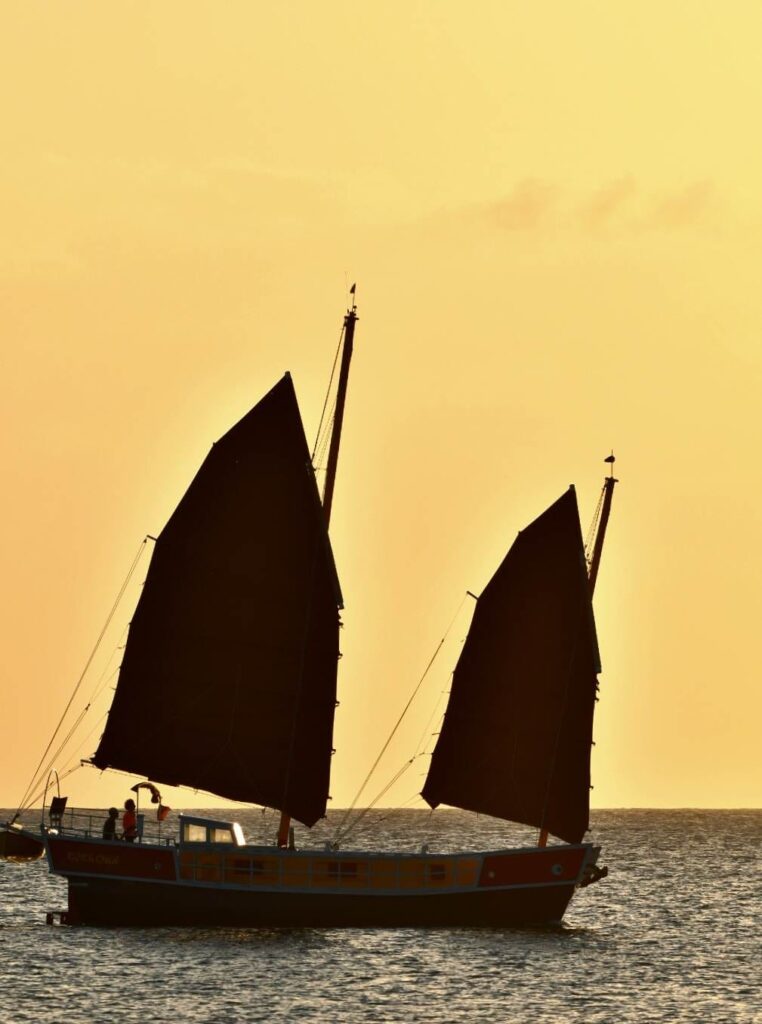
The main sail is 50 sq metres and the fore 30 sq metres, built with Weathermax 80 cloth using Arne’s camber sail design. It has taken a while to get the sails to set properly without too much friction on the mast, also because we had so many other things to focus on – and she sailed well anyway. Originally we were against Hong Kong parrels as we wanted to keep the rig as simple as possible, and they do have a bad press. However, Arne persuaded us to give them a try. So we did. They do work well and do not seem to cause any problems. The sails are set up with a four part halyard, a yard hauling parrel and a fixed throat parrel. There are also batten parrels. Still trying to work out the compromise between creases in the sail and too much tension on the Hong Kong parrels.
The yards are 4 ½ inch X 3mm alloy tubes and the battens are all 50mm x 2mm alloy tubes. During our transatlantic passage the top sheeted batten on the main bent after a couple of involuntary gybes in strong winds, and then broke, otherwise they seemed strong enough.
We are often asked: Has she met our expectations? Actually when we bought her we had no expectations or dreams. We wanted to try something different and she has definitely surprised us – by how well she sails and how comfortable she is at sea in rough conditions down below, we never strap up in the galley and we don’t have lee cloths. While she can roll a bit when sailing down wind or in a rolly anchorage, she heels little and does not slam. She is fun to sail and is surprisingly manoeuvrable despite her long keel and 13 tons displacement. However Linda struggles with the big, heavy rig on her own and finds that the lovely spacious cockpit in harbour becomes very exposed at sea when the going gets rough.
Pete Hill
PS:
Kokachin website has not been updated with the latest modifications to the rig and trim tab yet.
For an occasional Kokachin video on YouTube – link: @kokachin-junkrig-bl3vl