

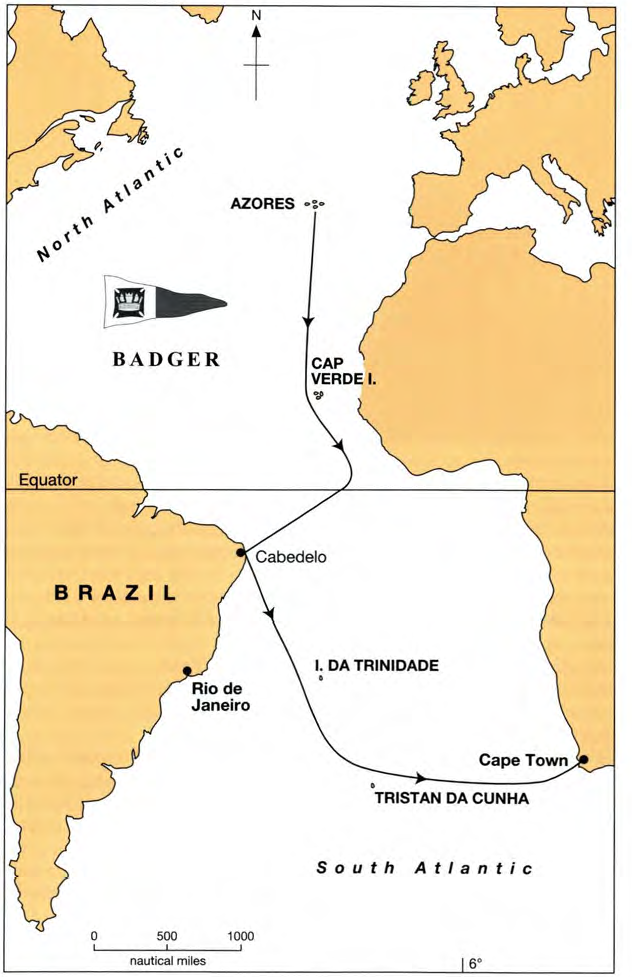
Cruising seems to be feast or famine. After the non-stop conviviality of the splendid RCC Azores Meet, we now planned to spend nearly three months on our own, sailing down to Cape Town with only a short stop in Brazil to have a break and replenish our water and supplies of fresh food.
On 3 August, a week after the end of the Meet, we motored Badger out of the marina in Horta and set full sail, heading south. What little wind there was came from the south, and the current between Pico and Faial was sending us slowly backwards. In the end, we motored for nearly an hour to get out of the current and then waited for the wind.
About midnight, a south-easterly breeze filled in and we were off. It backed a little and increased to force 4 overnight and we were soon reeling off the miles. Annie’s birthday was a legitimate excuse to have a particularly fine lunch, with a good bottle of wine. For the first week, the wind was light, but at least it remained free and we averaged 90 miles a day. By then we had arrived in the NE Trades and, for the next week, Badger made 120 to 130 miles a day. The Trades also heralded the start of the fishing season, with regular catches of small dorado. Usually, the only luck we have with fishing is in the trade winds, when there are flying fish about.
We passed close west of the Cape Verde Islands, but the poor visibility common to these islands meant that we never sighted them. The next day, 17 August, was officially Half-Way Day – another excuse for Annie to take extra effort in the galley at lunch time. It also marked the end of the NE Trades and our entry into the Doldrums.
We were fortunate in that conditions rarely fell calm, but the winds were usually light and from the south. As the wind shifted, we tacked for the more favourable course and slowly made progress south-east. emphOcean Passages for the World recommends crossing the latitude of 5°N between 17° and 19°W, and then to cross the Equator between 25° and 23°W. After ten days in the Doldrums, we crossed 5°N at 22°W, rather too far west. Then the wind came round to the south-east: the South East Trades at last – we hoped.
We tacked and headed for the Line, close-hauled, with the current pushing us west. There wasn’t much hope of crossing at the recommended longitude, but we couldn’t bear the thought of sailing east on the other tack, away from our destination. As it happened, we crossed the Equator (more celebrations) at 27°W and could then crack the sheets and head for Brazil, with the current now helping us. Five days later, on 7 September, we arrived off Cabedelo (about 60 miles north of Recife).
The coast here is low and featureless, but the city of Joao Pessoa, 10 miles to the south, showed up clearly and a ship at anchor indicated the river entrance. As luck would have it, we arrived in the afternoon, with the flood tide to help us tack the five miles up the River Paraiba to the village of Jacare. It had taken us 35 days to sail the 3,324 miles.
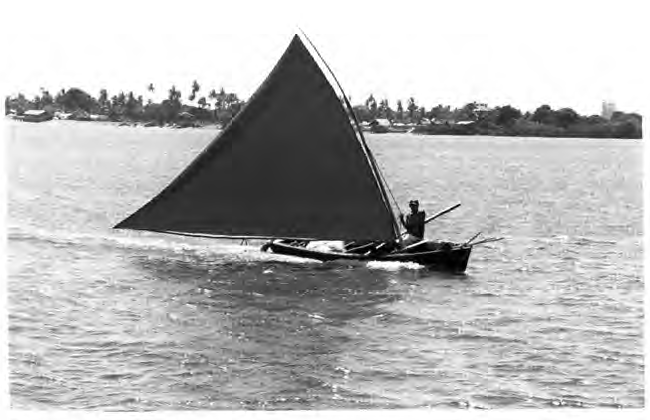
Jacare has been a popular stop for foreign yachts for many years. As well as having a good, safe anchorage and easy access to both Cabedelo and Jo˜ao Pessoa, one of the main attractions is Brian Stevens. Brian arrived in Cabedelo several years ago, by boat, and liked it so much that he never left and started a boatyard in Jacare. Brian’s main business nowadays is building fibreglass catamarans for beach charter, but he is always happy to meet the foreign yachts and help with any repairs or supplies that they need.
It was six years since our previous visit and we were looking forward to seeing Brian again, but he had gone to England for a visit. However his son, Richard, was now involved in the business and was keeping the family tradition going. We stayed for ten days, busily ticking off the jobs that we had to do and relegating many more to the next list. The only fly in the ointment at Jacare is the excessively loud and prolonged ‘music’ at the weekends, but this was easily cheated by going one mile upriver to anchor in peace – up wind of the noise. The biggest change in Brazil since our last visit was in the economy. In 1993, the inflation peaked at 2,500.
Cabedelo is right on the ‘bulge’ of South America and here the Westerly Equatorial Current splits north and south. We had to tack down the coast against a northerly set, in order to get south of Recife and find the south west current. The wind was firmly in the south-east and it took two days to get clear of the adverse current. We had hoped to visit Trinidade Island (20°30’S, 29°20’W), which lies 600 miles east of Brazil. It was more or less on our way and, with luck, we might be able to anchor for a night, even if it was unlikely that we could get ashore because of the surf. In 1890, EF Knight spent three months on the island, unsuccessfully digging for buried treasure and his adventures are related in his book The Cruise of the ‘Alerte’. The only inhabitants of the island are a small, Brazilian garrison. Unfortunately, the wind stayed in the south east and we came no closer than 120 miles. We had had more than enough of sailing close hauled and easily resisted the temptation to take a tack towards the island.
Never mind, Tristan da Cunha was also on the way. Tristan is the most remote community in the world; it is also difficult to visit because the anchorage is a roadstead open to the north. We had passed by in 1995, unable to anchor because of the north westerly sea that was running: maybe this time we would have better weather. On 14 October, we were about 100 miles away from Tristan, but the wind had picked up to force 7 from the north-east. Visibility was poor in the rain. Annie had got a dubious sun sight in the morning and I had snatched a rough meridian passage in the rain, so the resulting fix did not fill us with confidence.
There seemed no likelihood of anchoring at Tristan – even if we could find it in the thick weather. By hauling our wind, I thought we’d be able to clear the island by about 25 miles. The following morning, the wind had backed to the north and dropped to force 4, but there was thick fog. It lifted later in the morning and sights showed we were well clear to the north. Annie even thought she caught a glimpse of the summit of Tristan in a break in the clouds. Maybe next time we will be lucky.
We were now on the edge of the Southern Ocean and the colder water brought the birds – a constant delight. Storm petrels, shearwaters, shoemakers, Cape pigeons, yellow-nosed and black-browed albatross and of course, the great wandering albatross, with its eleven foot wingspan.
The wind stayed in the north-west for several days, blowing at force 4 or so and giving us good runs as we were now ‘running our easting down’. Eventually, it went round to the south, then quickly through east and back to the north. As the barometer started to go up, the wind backed round and then blew hard from the south-east, with a high glass. The wind kept up for the next four days, reaching gale force at times. The seas quickly grew and it was a very uncomfortable time aboard Badger. We continued on our way, most of the time reefed down to the top panels of each sail.
The gale eased on 28 October, by which time we were only 150 miles from the Cape. Frustratingly, the wind then went light, but the visibility was exceptionally good and Table Mountain appeared on the horizon, 60 miles away. It was, however, another 24 hours before we tied up in the Royal Cape Yacht Club.
The last few minutes of the passage proved to be the most traumatic. Our diesel engine is normally very reliable, but as we jilled around in the Duncan Dock, it stubbornly refused to start. Eventually, the much depleted battery summoned up enough energy and the engine fired. All well and good, as we stowed the sails, but then the engine started to die as we approached the marina. As I disappeared below, Annie hoisted the sails and sailed up and down the dock. The fuel line had split, but a hasty repair soon had the engine going again and Badger tied up.
It had taken us 41 days to do the 3,900 miles from Brazil and we were looking forward to a few weeks in harbour. Cape Town is such a friendly place, that within hours we were involved in a feast of conviviality, in stark contrast to our retreat at sea.