

When I was going to become boatless (read ‘homeless’), Linda and I compiled a list of requirements that we were looking for in a future boat. The boat had to be suitable for short-handed ocean passages, large enough for two to live on board, but small enough for me to be able to handle on my own. This also meant roomy accommodation, sizeable tanks, insulation, heating and ample storage area. We also wanted good sailing performance, shallow draught, moderate displacement, junk rig (ideally), a reasonable price and for the boat to be conveniently located for our current location and future sailing plans. Needless to say it was not easy to find a boat to meet this specification, and we needed it quickly, here and now! At the time we were in New Zealand and Linda was flying back to Croatia for a short while. Once reunited, the plan was to sail to some cold and desolate destination.
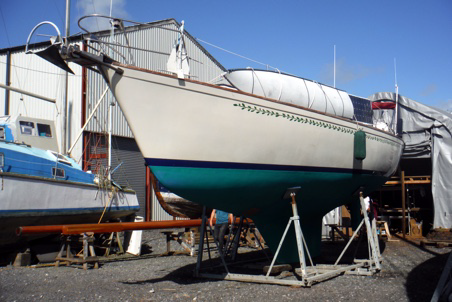
Oryx was up for sale and my New Zealand visa was about to expire so the pressure increased to find a new home. An internet search for junk rigged boats for sale, brought up Raggedy Edge, a Pearson 367 lying in Florida. She appeared to be in good condition, was a suitable size, had lots of equipment, and was very reasonably priced. I bought her sight unseen and booked my ticket to Florida.
The boat had been converted to junk rig by the previous owners. She had a nice, hollow wooden mast and a well-made flat sail, which was really too tall for the length of the mast; and the battens looked far too light. I spent two weeks sorting the boat out, strengthening the battens and buying extra wood for repairs, amid much rain and thunderstorms, as the first tropical storm passed by, in the Gulf of Mexico. I renamed her Blossom.
My original plan was to sail Blossom up to the Chesapeake Bay, out of the hurricane belt, and make some modifications there. Instead I decided to sail back to the UK to do the work there. To avoid the hurricane season, I needed to get moving quickly.
After a long and eventful Atlantic crossing, during which Blossom looked after me well, I arrived in Falmouth at the end of July. Moving on to Millbrook, East Cornwall, I hauled her out at Southdown Marina to start the repairs necessitated by the voyage, and commenced converting the rig to turn her into a fine cruising boat.
1 Mast
The mast was put in to suit the accommodation – which means that the rig needs a lot of balance forward. To achieve this, the obvious choices were aero junk or split junk. As I had a good experience of aero junk I decided to go with that. I also wanted to try using extruded fibreglass battens instead of wooden ones. We chose this option because of its apparent simplicity, but it was more work than we would have hoped, because we could not get sufficiently long battens, which meant that they had to be joined. This took quite some time and effort: making the battens was a lot of work and in retrospect, a split junk might have been a better choice.
The beautifully-made, bird’s-mouth, douglas fir mast was too short for the boat and it hadn’t been fibreglassed. I extended it by 3 feet, fibreglassed it with unidirectional glass and cloth, then epoxied and finished it. The halyard block is held at the masthead with a thick dyneema strop.
2 Sails
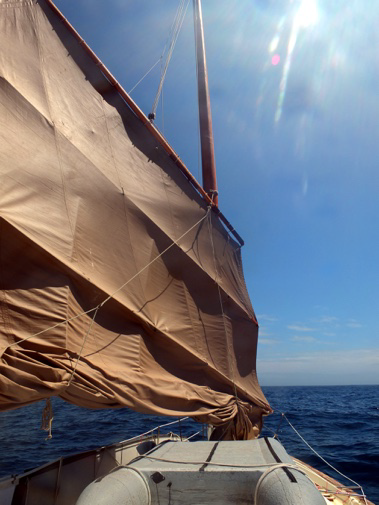
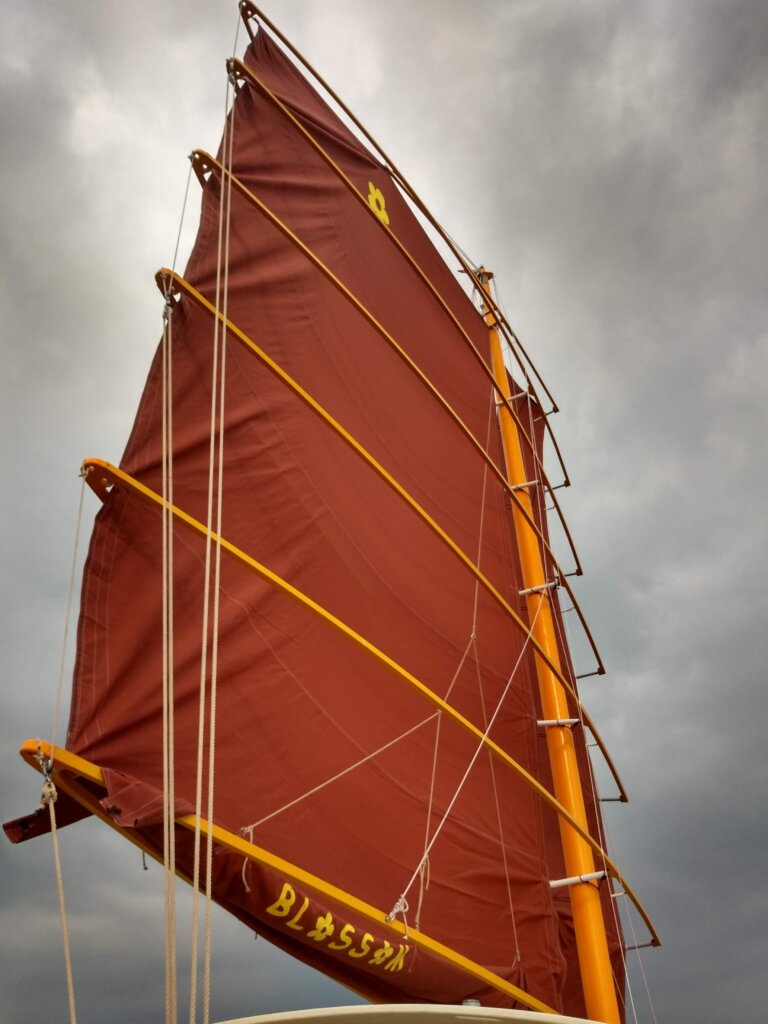
The sails were made on Linda’s houseboat in London, over the Christmas period. They were easy to make as all panels (except the top one) are squares of the same size. Making the sail catcher took more time, but I really wanted to make one, because they keep the sails tidy and protect the sail cloth from UV damage. The sail cloth was 6¼ ounces, tan Clipper Canvas.
3 Battens/Wishbone
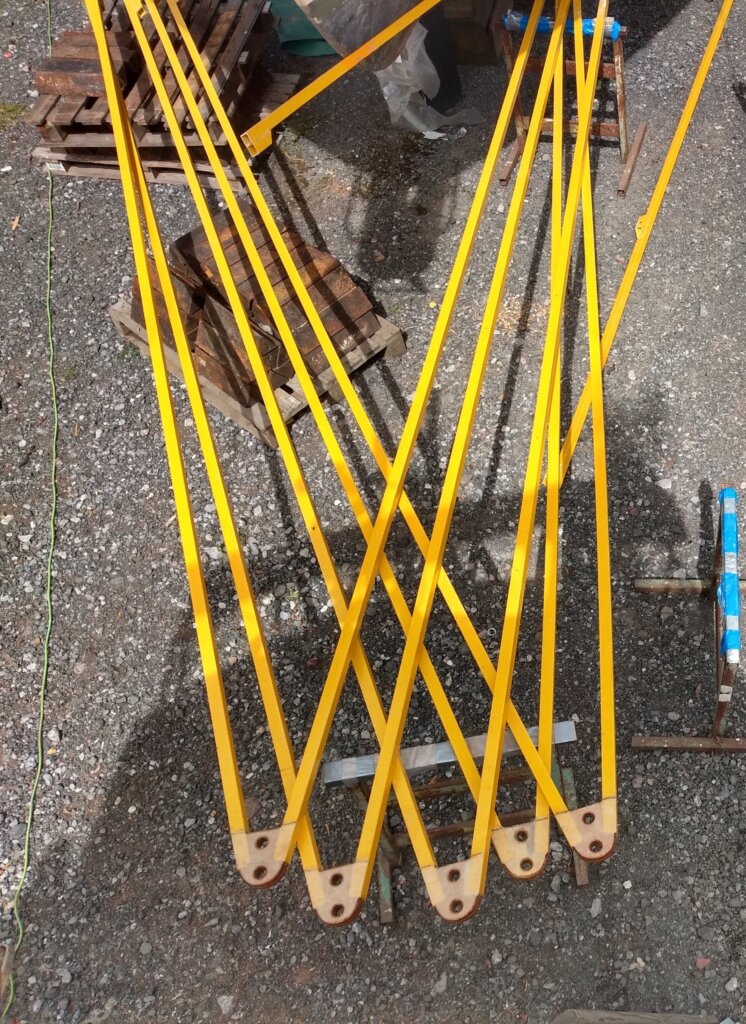
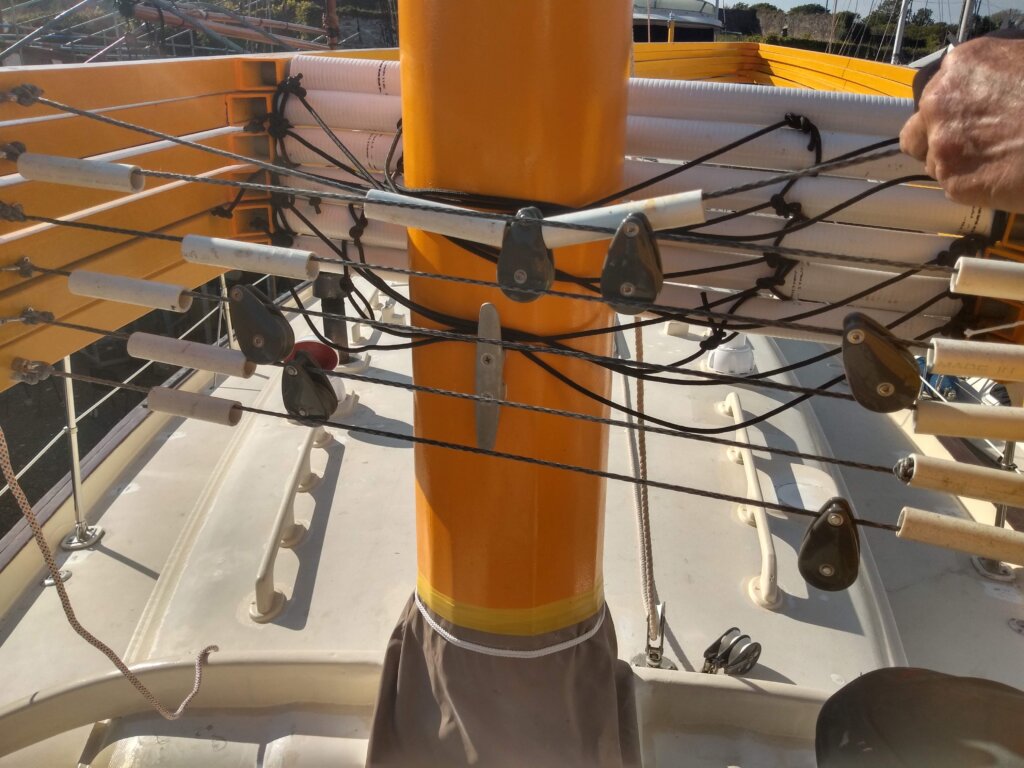
I bought 5m pultruded square tubes, which as I mentioned, had to be extended. I did this by putting a 10 cm long wooden plug inside the tube to strengthen the joint and covered it with glass/ epoxy. The cross beams for the wishbone were made of round fibreglass tubing. To join the wishbones at the after end, I made a plywood wedge with a recessed tube. I stretched dyneema across the wishbone, for the horse, for the jiblets and added a small block acting as a traveller. The front of the wishbone had another round tube joining the two ends. There is a need for steadying the wishbone/sail bundle when the sail is down, with restraining ropes at the top of the cuddy, which works well and is simple and quick to do.
4 Cuddy
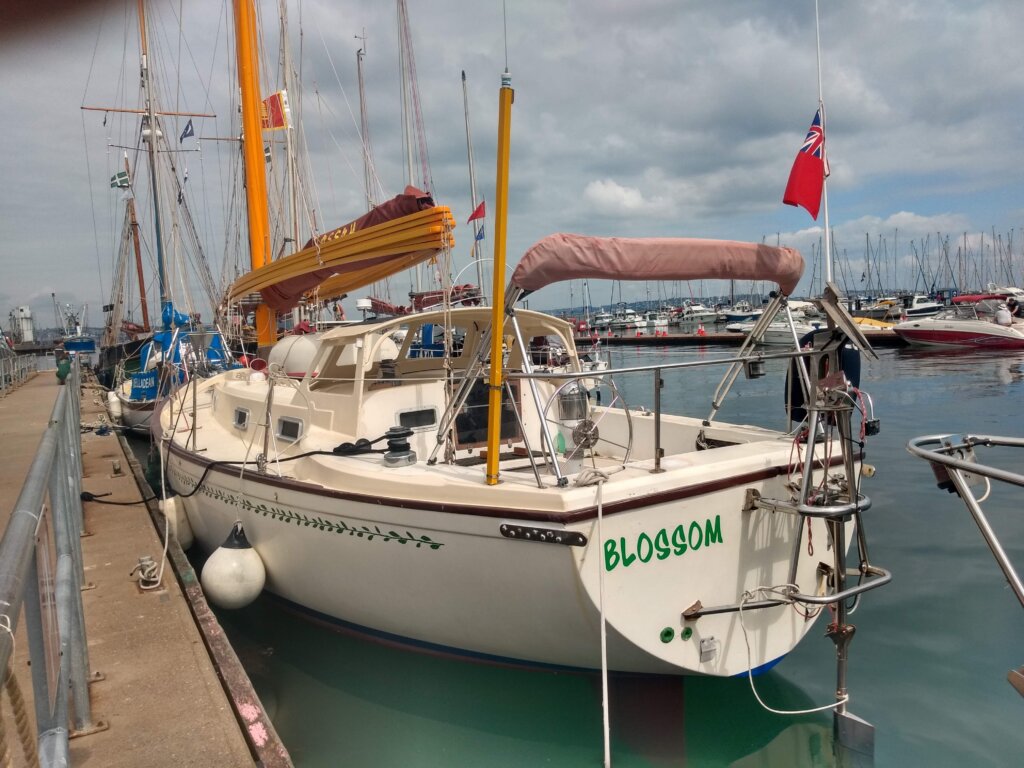
I made a new cuddy (12mm plywood side and 6mm top, epoxy finished with 5mm polycarbonate windows). The involved 3D puzzle was complex to make on the top of the rounded, sloping cabin and decks, with nothing to provide support while designing it – not to mention the wind knocking it off as I was working on it. It gives much appreciated shelter and does a very good job. This, plus the many compliments we received from passers by made it worth the effort put into building it.
5 Engine choice
The boat had had its engine removed and replaced with an outboard. After much deliberation about electric, diesel or combination of two I decided to go for Beta 25, saildrive diesel engine. I felt that electric or hybrid technology and the batteries have not reached their optimum development and either is still quite an expensive choice. While I use the engine very seldom, it is nice to know that there is the potential to motor for quite a few hours if needed and I felt the electric engine would not yet deliver this. The old engine beds had to be removed and that was far from easy and working in a confined space, with fibreglass dust like flour covering me was very unpleasant. At that time I did not use an air fed mask and an allergic reaction caused me to come out in a rash all over my face, hands and legs!
Cutting the hole for a saildrive, through thick fibreglass, was another unpleasant task to deal with, but once the engine was in it all looked good and I am happy with it. The two bladed folding propeller works well with minimal drag.
6 Sailing
The pressure was on to launch Blossom in early May, so that we could do some sailing trials before the JRA AGM in Brixham at the end of that month. As it turns out we only launched her 7 days before the event. Our first sail was to Cawsand, then to Dartmouth (Dittisham) and Brixham, where we met David Tyler sailing on Weaverbird. Needless to say, there was no time to properly test the rig.
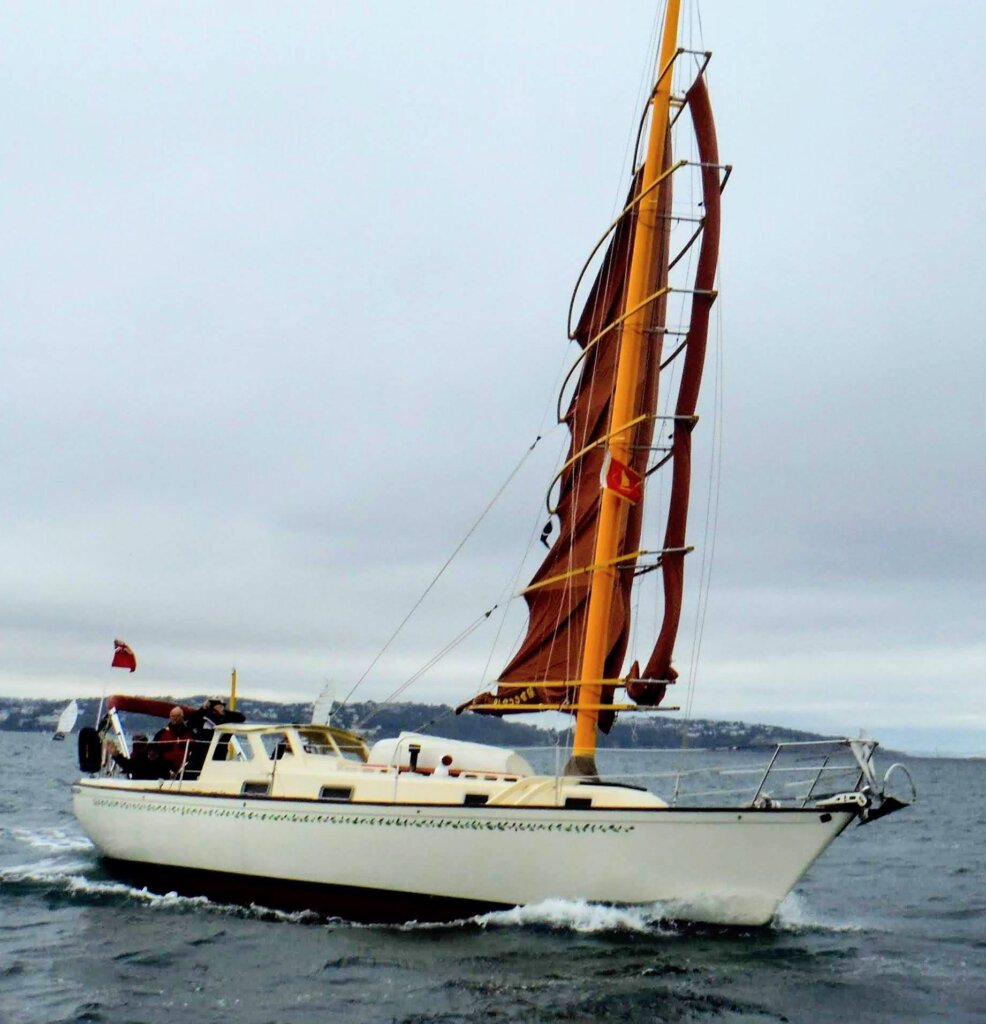
After the AGM in Brixham, we cruised west, back to Plymouth and then on to Falmouth and the Isles of Scilly. Blossom sails very well and is well balanced. She seems to be quick and tacks like a dinghy, keeping her speed up through the tack and not falling off, before picking up on the new tack. The main does set with some creases at the top and It appears that while the battens and yard are strong enough they are not quite as stiff horizontally as they should be.
She has a very roomy cockpit and although she has wheel steering, there is room to pass by the helm. We fitted two 2 inch draining tubes astern (above the water line) to add to two existing cockpit drains with seacocks. Her side decks are wide.
7 Interior
Once we started living on Blossom, her shortcomings became more apparent, especially to Linda. Everything was either too high or too big for her to feel comfortable, especially after Francis (which is a gem of minimalism and functionality). As for me, who has mainly lived on his home-built/own design/modified design boats, not being able to alter things was quite frustrating: she has an inner moulding. For me, Blossom worked OK and I said that I could sail on almost anything and be happy. Making changes to her accommodation would have meant destroying most of the interior, and we really didn’t feel up to it.
We made some limited improvements to her interior setup: moved the dining table and the stove; removed the double bunks in the saloon; removed all the pressurised water system; blocked seacocks below the waterline and numerous draining holes in the cabin, which were part of a water collection system. Importantly, we insulated the hull with three layers of aluminium bubble wrap, finished off with carpet. This is our second winter living on her and the insulation has proved to work very well.
New Project
Quite unexpectedly on returning to Plymouth, we heard about a partially completed Forestier 12.5 junk for sale near Paris. This seemed too good an opportunity to miss: while we were looking forward to cruising again the Forestier would be a much more suitable cruising home for us both. We flew over to take a look, bought her and then arranged her transport back to Cornwall. It sounds simple, but entailed a few nail biting weeks while Linda coordinated English transport, a French crane and lastminute document delivery to France. After that was organised we had a few weeks to wait and so sailed in Blossom to Falmouth and then on to the Scilly Isles, having a delightful holiday. Once back in Millbrook we hauled Blossom out at Southdown Marina and when our new boat, Kokachin, arrived, she was placed alongside Blossom. As work progresses on Kokachin we can live on Blossom, a three step commute away. When we finally move aboard our new boat, Blossom will be for sale.