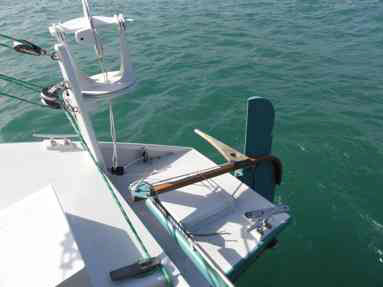
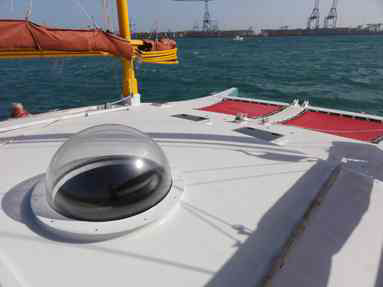
Oryx is a modified KD860, designed by Bernd Kohler. The main alterations I made to the design were to lengthen her from 8.6 metres to 10.0 metres and, of course, to change the rig to a junk. There were many other modifications, so that the completed boat is very different from the standard design.
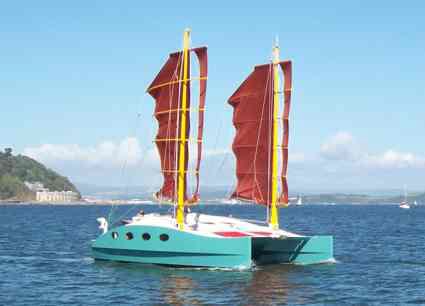
Oryx’s dimensions are:
- LOA 10.0m (33ft)
- LOA 10.0m (33ft)
- Beam 5.6m (19ft)
- Draught 0.6m (2ft)
- Sail area
- 51.5 sq.m (544 sq ft)
The rig has side by side split junk sails. I got the idea from Poppy’s rig, and I am grateful for much help from Slieve McGalliard. Instead of bulging panels I made half wishbooms with the sail loose footed and attached only at the luff and leech to each batten. The jiblets are set on hinged boomlets, again loose footed.
The rig works very well but there is a lot of weather helm when going to windward, even in light winds. I am not sure why this is so, as on paper she should be well balanced. Oryx does not have keels, and the hulls, aided by antivortex panels, are used to prevent leeway. Maybe this changes the usual centre of lateral resistance.
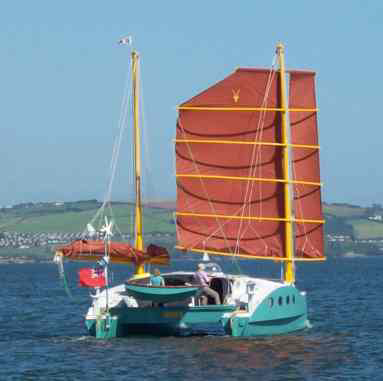
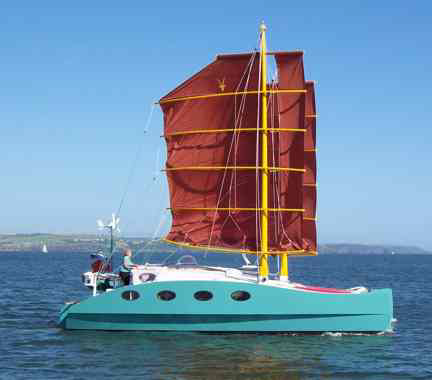
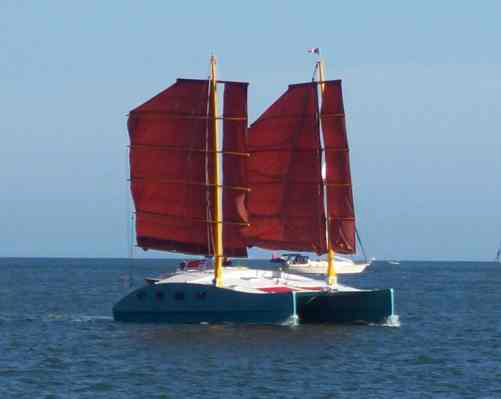
Something will have to be done to correct this, either altering the rig or putting keels on the hulls. When reaching, there is some interference between the sails, but this is a fast point of sail, and the interference can be eliminated by a small change of course. Sailing downwind is wonderful, with the balanced sails making gybing easy and safe in all winds. With the sails ‘wing and wong’, Oryx will almost steer herself.
The self steering is by a pair of Bill Belcher OTG I windvanes, connected to the tillers directly. The windward one is used until the wind is on the beam; and with the wind abaft the beam, both can be used to double the power.They work very well, but close hauled the excessive weather helm makes them struggle a bit. Down wind they work extremely well, steering a very straight course, even with spurts of over 10 knots.
Oryx has one engine in the starboard hull. It is a second hand 18 hp Volvo 2002 saildrive, with a 3 bladed Kiwi prop. It works very well, but being one sided it makes manoeuvring in tight spots very difficult. Top speed is a little over 6 knots.
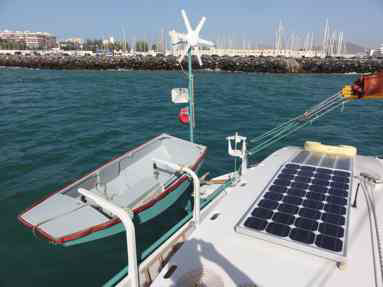
Electricity is generated by two solar panels (total 120 watts) and a wind generator, and is stored in two 6 volt golf cart batteries, giving 200 amp hours. So far we have rarely been short of electricity. All the lights down below are LED and the tricolour light is also LED.
Sailing instruments are a compass, a barometer, an echo sounder, a small GPS/chart plotter and a combined VHF/AIS set.
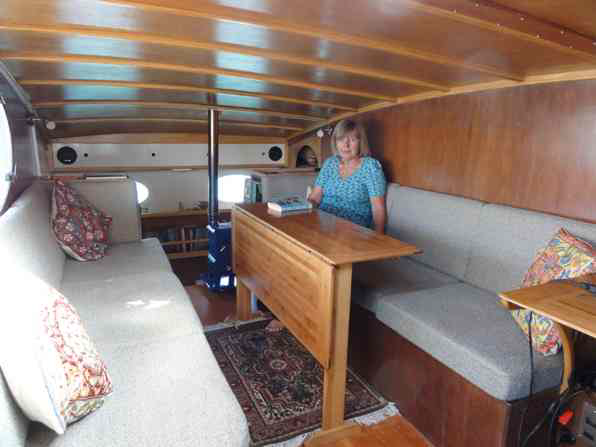
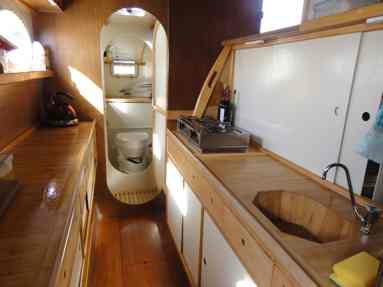
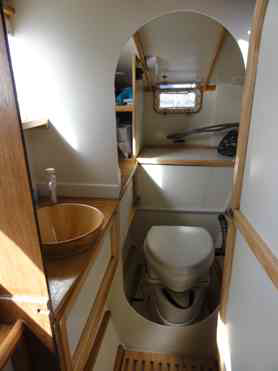
The pictures of down below should explain the layout. We cook on a two burner alcohol stove and like it very much, it uses on average 2 litres of alcohol a week. After 30 years of being a pressure paraffin fan I have changed because of the difficulty of obtaining paraffin and the very high cost of spare parts.
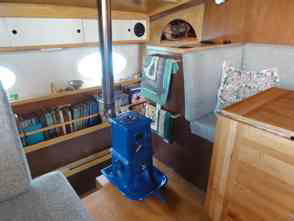
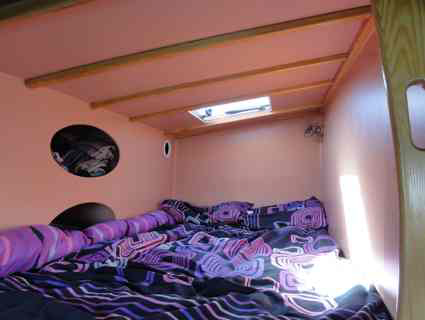
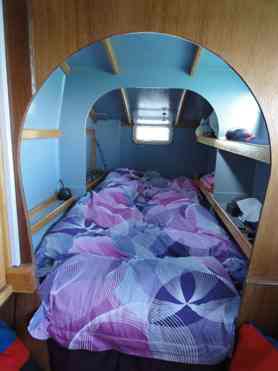
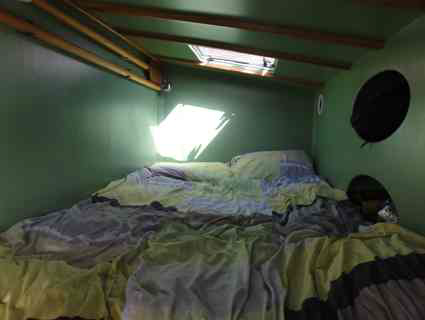
The heads is a ‘Natures Head’ composting toilet. It works by separating the urine from the solid waste. The solid container is primed with 6 litres of peat and each time the toilet is used a handle mixes the contents together. The urine container needs emptying every two days and the solid container every month (with two people). There is virtually no smell and it seems to be the best solution to a difficult problem.
The dinghy is a Bolger Nymph, an 8 foot plywood dinghy with a sailing rig, but no outboard.
Oryx took 2 years to build, largely single-handed. I have not added all the invoices together , but she cost a little over £20,000 (my labour being free). She is our cruising home, and is very comfortable at sea and in harbour. As soon as I sort out the weather helm problem, she will be a great boat.