China Moon was designed to be a comfortable cruising Catamaran to be used for long voyages to remote cruising grounds. Fitting a junk rig on the boat was a major consideration. Having read about the successful junk rigged catamaran ‘Dragon Wings’, designed and built by Gary Lepak, I felt it feasible to design my own boat.
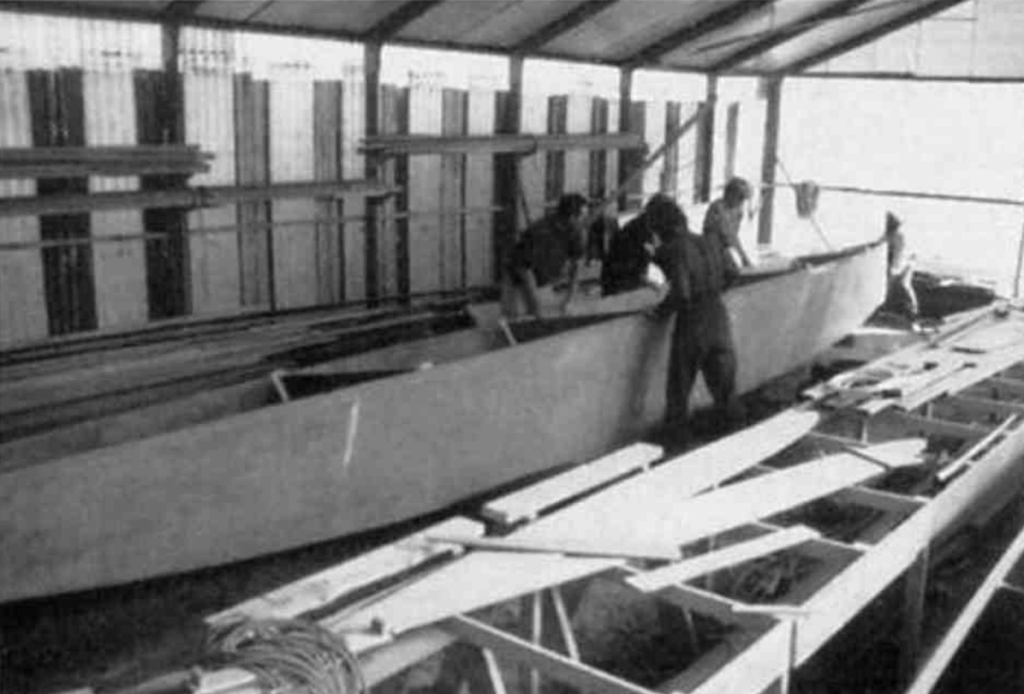
China Moon was built in South Africa over a period of 3 years. South Africa was chosen as a country with good access to materials, inexpensive and with a good climate, it proved to be a wise choice.
I used a hard chine design program called ‘Plyboats’. It ran in DOS and was very simple but it gave all the design outputs of displacement, centre of buoyancy, centre of lateral resistance and expanded offset tables for the panels.
- The hulls were dory shaped with flaring topsides and the hulls were built in two halfs.
- The lower half was built of 12mm plywood sides on 30mm stringers, over bulkheads, with polystyrene foam between the stringers and an inner layer of 4mm plywood.
- The bottom was a layer of 12mm plywood.
- The lower hulls were built upside down and then rolled over.
- The upper hull was then built on top with bulkheads, stringers, foam and 9mm plywood on the outside and 4mm plywood on the inside.
- The cabin and deck were built the same way but with 6mm plywood on the outside.
- The inside was completely coated with several coats of epoxy and then varnish or paint.
- The outside of the boat was sheathed in glass and epoxy before painting.
- The low aspect ratio keels are 10 feet long and 18” deep, built of plywood.
- The keels are hollow and form the diesel tanks, holding 175 litres each.
As launched there was no cuddy over the front of the cockpit, but the early cruise to Patagonia revealed how exposed the cockpit was and the addition of the cuddy made a huge difference to the shelter in the cockpit.
An 8′ dinghy lives in davits behind the after beam, which makes launching extremely easy. On passage the dinghy is stowed on the centre deck, just forward of the cuddy.
China Moon was originally launched with a 27HP Yanmar 3GM30 saildrive in the Starboard hull. This proved completely adequate, as long as not needing to manoeuvre in tight places with any wind blowing.
The new owner of China Moon subsequently (in 2010) replaced the engine with Yanmar YM30 saildrives in each hull, making the boat very manoeuvrable. The engines have 2 bladed folding propellers.
A 1:12 scale model was built of China Moon to test the balance of the rig in relation to the hull, rudder and keel. It was found that because multihulls hardly heel the COE of the sail does not need any lead over the CLR of the hull.
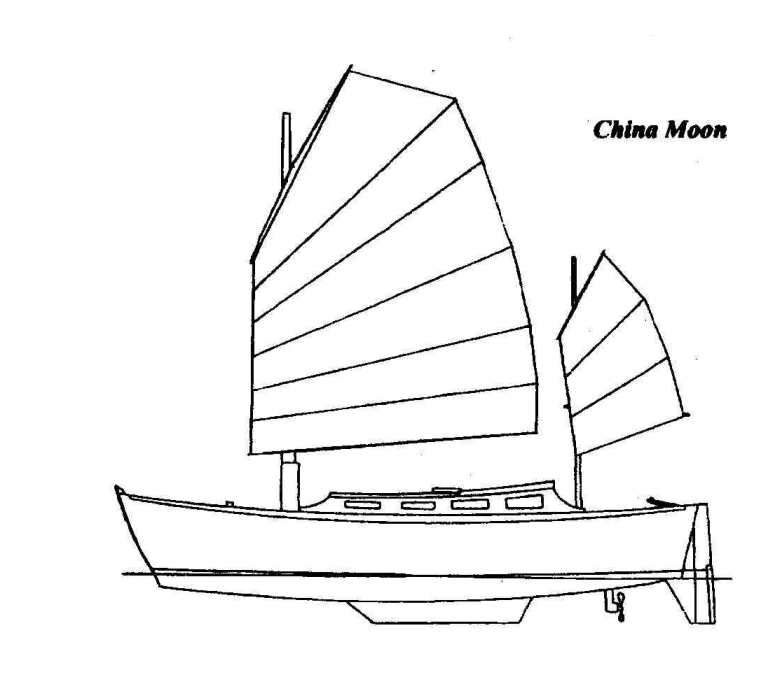
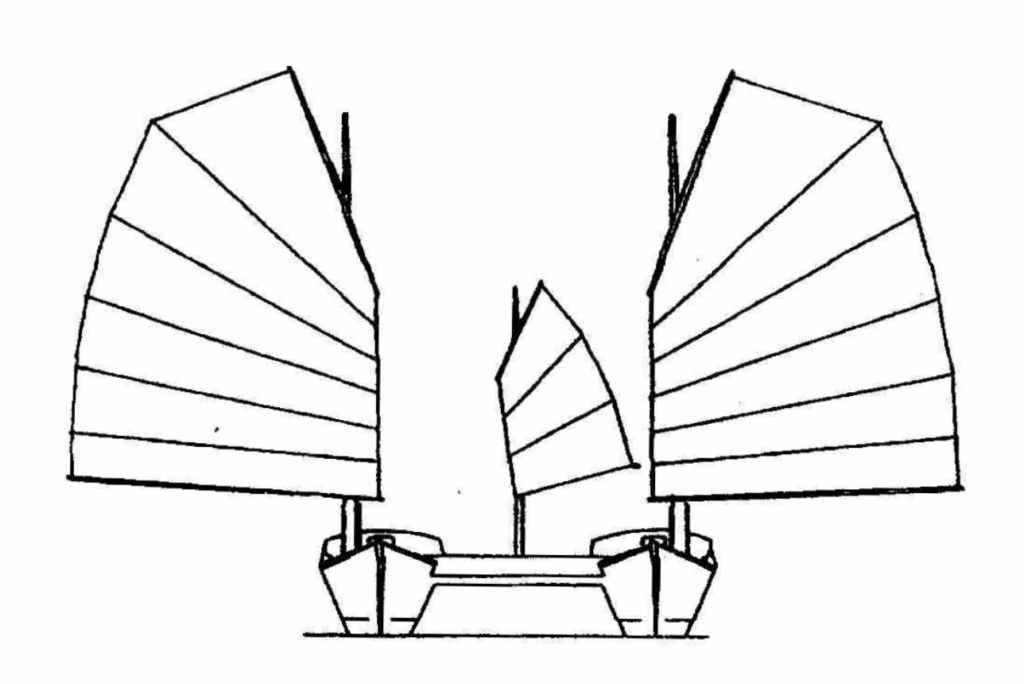
- The rig is a biplane junk rig with the masts set at the outboard edge of each hull in tabernacles.
- The hollow masts are Douglas fir built using the “birds mouth” 8 stave method, covered in glass and epoxy.
- The rig is a slightly modified Reddish rig with articulating battens.
- The battens are made of 1 1/2” alloy tubed with unidirectional carbon fibre covers.
Originally there was a mizzen sail mounted on the centre line, on the aft beam. This was designed as an ‘air rudder’ to help with tacking, but China Moon is exceptionally good at tacking on her own and the mizzen was removed.
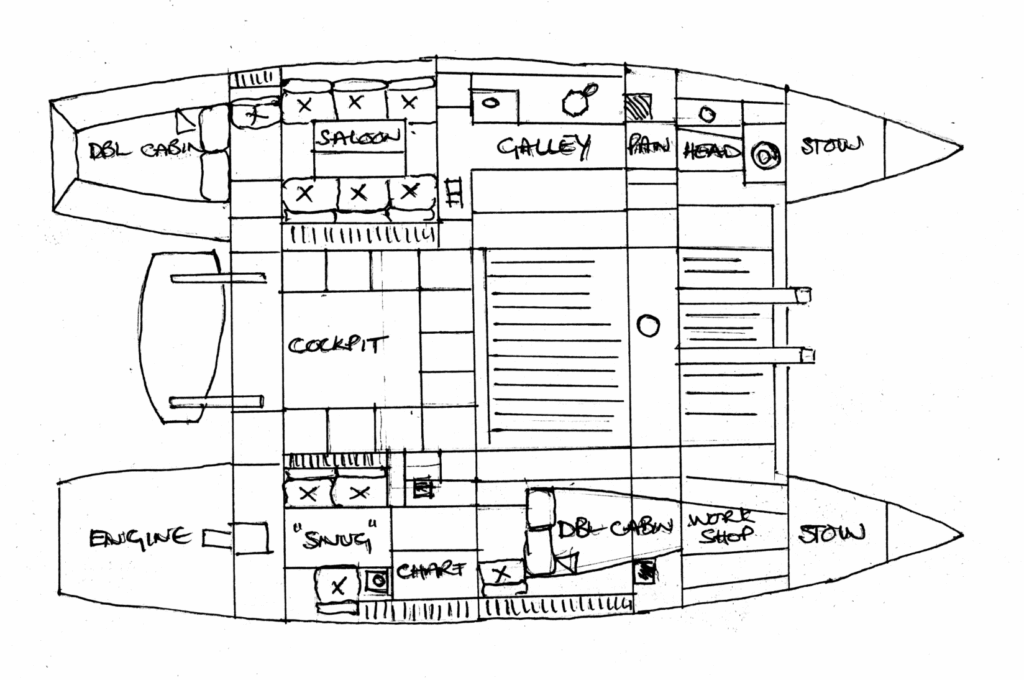
The accommodation down below is as follows:
Port Hull
Forward in the port hull, we have a sealed, watertight compartment that serves as a collision bulkhead, keeps weight out of the bows, and provides space for empty jerricans. Some of these will hold extra fuel in case we intend to be away from civilisation for an extended period of time, while others will provide additional water for lengthy voyages.The heads compartment is located abaft of that. The heads themselves are at the forward end, with a wash basin on the port side, with storage underneath.
Heads
The heads’ own hatch makes it easier to use from the deck and eliminates the need to constantly walk through the galley. With floor-to-deckhead vegetable racks on one side and an oilskin locker on the other, the space between the heads and the galley is essentially a vestibule. At the forward end, there is an opening scuttle.
Galley
In contrast to Badger’s fantastic galley, the galley on China Moon is big. Additionally, we plan to use this hull at sea, especially in bad weather, so the counter area behind the Dickinson diesel cooker/heater will serve as a makeshift chart table. In addition, we’ll have a permanently mounted single-burner paraffin cooker, in use when in warmer climates. There will be plenty of room for lockers.
Saloon
The raised saloon along the entire width of the hull, will also heat this area more efficiently.
Six people may comfortably sit in the saloon, which is 6 feet 6 inches long, and eight people can squeeze in.
There is plenty of book-shelves and storage in the galley.
Many, double glazed, windows along the outside of the hull (galley and saloon) offer uninterrupted view and provide plenty of natural light inside, when underway or at anchor, while cooking, reading or just relaxing.
On the inboard side of the saloon there will be bookshelves in place of a window. Another window is looking into the cockpit, which is useful .
Twenty-two fifteen- liter water containers will be stored beneath a table that runs along the centre.
Sleeping Cabin
Past the saloon, there is the after-sleeping cabin which has plenty of headroom as well as storage underneath and at entry. It is placed in the most comfortable area of the boat. This bunk, which is four feet wide at the head, will serve as a berth for guests and is suitable for cold weather or at sea when we are keeping watch. There is plenty of storage underneath it and some shelves on entry.
Starboard Hull
The bow of the starboard hull also has an enclosed, waterproof chamber. There is a workshop with a suitable small workstation where we will store tools, paint, fenders, ropes etc. The workshop is separated from the next cabin by a completely watertight bulkhead. This, yet another watertight compartment, will keep the smell of paints, etc. away from the rest of the accommodation.
Master Cabin
The next cabin aft is a sleeping cabin, which we intend to use as much as possible, but certainly in harbour and in hot places. There is a good, 4ft 6ins wide double berth, with clothes lockers either side and another bookshelf, above which there are windows along the outboard cabin side.
The front of the cabin has an opening scuttle. There is a hanging locker and a little seat for comfortable dressing aft of the cabin. There will be additional lockers here because of the little wings. To prevent water from seeping into the sleeping cabin, a sill separates the floor from the chart room.
Chart Table
There will be plenty of room for charts beneath the full seize chart table and for books above it.
The ladder is across from the chart table.
Additionally, the cabin’s exterior has windows – the same as in the port hull.
As we will have to cross from one hull to another in the pouring rain and subsequently dispose of wet clothes, there is an oilskin locker here.
In order to utilize the entire width of the hull and view out of the windows when seated, the area behind the chart table is raised (as in the port hull).
“Snug”
A portion of our library and a small solid fuel stove will be here. There will be a built-in table for computer so we can write in privacy and comfort. For chilly mornings or evenings, that don’t require a Dickinson range to be lit up, we may use this ‘snug’ space as a place to warm up and relax.
We’ll need to see how it functions in actual use before we can be certain. Another advantage of this arrangement is that if we have a couple staying with us, we can turn this hull over to them in its entirety, which will give both plenty of room and privacy.
Engine Room
The engine room, which is large enough to provide adequate access to the engine and enough room to store a few bicycles, is located in the after end of this hull and is once more divided by a completely waterproof bulkhead. The reconditioned Yanmar 3GM saildrive engine is ideal for a dory hull.
“Won’t we go round in circles?” is the typical question we are asked. Our reading suggests that it won’t really be an issue unless we use marinas, which is not our plan.
Other JR Boats
Bob Bums of Roamer lied here for a whale during his circumnavigation. He visited us a short while ago and might be bringing Roamer here in November. Therefore, there is a chance of three junk-rigged boats being in the water at once at Port Owen Marina!