

This is the cruise for which the RCC Challenge Cup and the Goldsmith Exploration Award were presented.
It was with some trepidation that we sailed from Stanley in the Falkland Islands, outward bound for the Antarctic.
Our original plan had been to visit South Georgia and then sail on to Cape Town. In the winter, during the celebration of some trifling event, Annie commented that it was a pity to miss out visiting the Antarctic when we were so close. Sober, the next day, she came to regret her light-hearted suggestion. The South Shetlands and the Antarctic Peninsula were too far in the wrong direction, but the South Orkneys were almost on the way and had the advantage of being less frequented. It seemed too good an opportunity to miss and Annie agreed, excited and appalled at the same time. Over the winter, we had installed an 18 hp air-cooled, diesel engine, that we had been given for a very reasonable price. It is doubtful if we would have attempted this trip with our previous Seagull outboard.
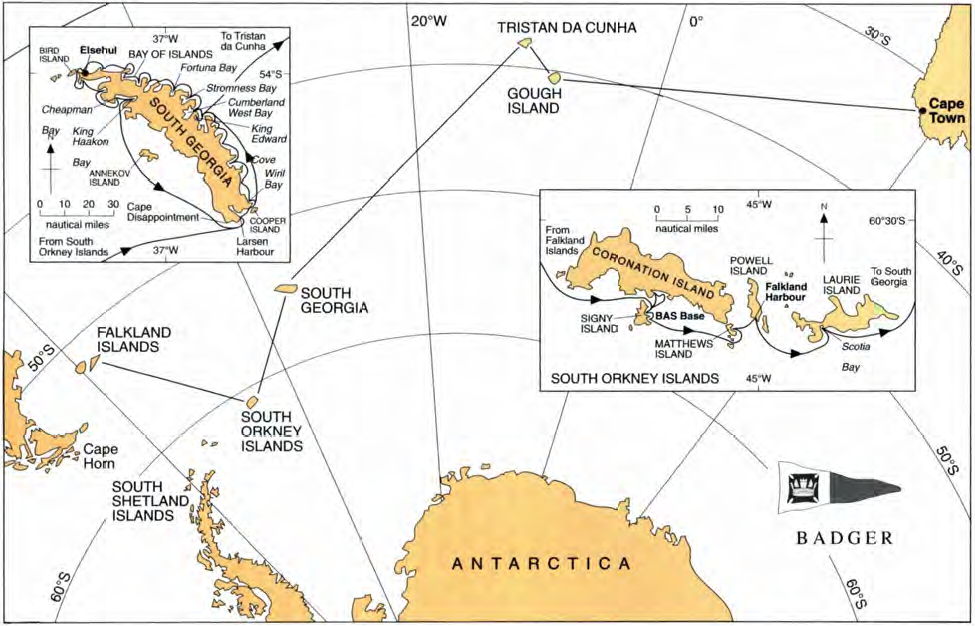
We had decided to leave on 15 December. This would give us the max imum daylight for seeing icebergs and we hoped that the South Orkneys should be free from ice by then. The north-west breeze was slowly increas ing all morning as we made our final preparations. Howie Peck came aboard to bid us farewell. He had been the engineer aboard RRS Shackleton who repaired Mischief ’s heater when Bill Tilman was at Deception Island. By lunch-time, the wind had increased to such an extent that we were a little loath to set out, but our berth at the end of the Government Jetty was only just tenable in a north-westerly. We decided to go and once through the narrows, the wind was free and we raced offshore heading south-east. By evening the breeze had dropped to F4-5 and the conditions were perfect.
The wind went round to the south-west and eased off before filling in again from the north and increasing up to F6. This brought in overcast weather and then fog and it remained foggy for much of the rest of the passage. We were in the iceberg zone, so a particularly good lookout was kept and we were both quite tense, peering into the fog. I sighted the first iceberg at breakfast time on 20 December. We had the Perspex bubble on as it was rather chilly and the fog seemed to be thinning ahead, looking as though the sun might peep out. This brightness turned out to be an iceberg, alarmingly close. Even in the thick fog, we could see the waves surging about its base and there were many growlers about. I jumped out on deck and steered by hand around them. The breeze was light and we were thrown about by the backwash, breaking one of the battens, but we were soon out of the brash ice around the berg and back alone in the fog. Hereafter, we never used the bubble again as it blocked out too much noise; the iceberg was clearly audible even though hidden in the fog.
The fog hampered navigation because, although a weak sun was visible from time to time, the horizon was very dubious. I took sights anyway – something is better than nothing. On one occasion the horizon simply had to be guessed at, because the visibility was less than 100 yards, even though the sun was clear overhead. These sights seemed to tie in with the DR so we pressed on although one night we had to heave-to for three hours because it was too dark to continue. Next day, the visibility improved a litde and more confidence could be placed in the sights and that evening Annie sighted the Inaccessible Islands, 17 miles off and a litde to port of our course. We had made it and there was no sign of pack ice, although there were many icebergs about within the 100 fathom line. We sailed on overnight and along the south coast of Coronation Island to Signy Island, where there is a good anchorage. Breakfast time on 22 December found us anchored in the north of Factory Cove (60°42’S, 45°37’W), the site of the British Antarctic Survey base, which looked very small surrounded by grand but austere scenery.
We went below, lit the fire and had a good breakfast. An inflatable zoomed out of the bay and a short while later came alongside, Russ Man ning, the BAS boatman was calling to welcome us. After a brief chat, he roared off again to pick up some field workers. I must admit that we were very elated to have actually made it to the Antarctic — it seemed so im probable. As we rowed ashore to see the Base Commander, a cruise ship steamed slowly past Signy Island.
Martin Davey, the Base Commander, met us as we landed at the slip. He made us very welcome, giving us a tour of the base and inviting us to lunch in the dining room. We went off for the afternoon to the north of the island with a penguin-counting party. After dinner ashore, seven of the base came out to Badger for what turned out to be a party – quite a first day.
We slept late the next morning and then went for a long walk to the south of the island to see a Chinstrap and Ad´elie penguin colony. It was also the breeding season for skuas and we had several nerve-racking attacks from them because we had forgotten to take a stick to hold up over our heads: never again.
That evening Martin came to dinner and invited us to share Christmas with them if we were still at Signy. We gratefully accepted because we had hoped to stay there as it is a good harbour and we were looking forward to being safely anchored for Christmas Day. The Christmas celebrations were a splendid affair. They started with a traditional James Bond film in the afternoon, with roast turkey in the evening followed by a party in the bar that apparently fizzled out just before breakfast. Even so, we had quite a few takers for a Boxing Day sail the next morning. We sailed in company with the Base launch over to the Sunshine Glacier and had lunch at Shingle Cove (60°39’S, 45°34’W). There were ten of us on board for the sail back to Signy.
The people at Signy were a marvellous group, hard-working but with a great capacity to enjoy themselves. A third of the scientists were women, which was a surprise, and many of them were recent graduates. It was with regret that we said good-bye and, after dropping off our guests, sailed around to the next bay for the night.
The weather was crystal clear the next morning as we sailed along the south coast of Coronation Island with a fresh wind from astern. After passing through the Robertson Islands, we found an anchorage in the lee of Matthews Island (60°44’S, 45°09’W) for lunch. It was then a short sail over to Powell Island.
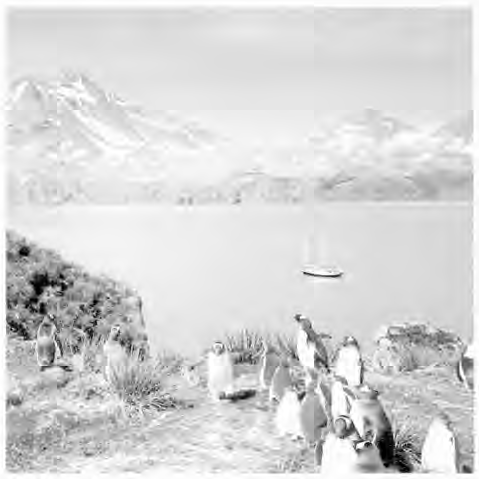
Falkland Harbour (60°43’S, 45°06’W) at the south end looked very promis ing, but the Pilot advised against it without giving any reasons. We sailed in to what appeared to be a well-protected spot, quite small, but none the worse for that. The anchorage was put to the test next day when a westerly gale came through and showed that we were safe and snug. The whole area around Falkland Harbour is a Site of Special Scientific Interest and landing is not permitted. The shore is covered with a large, mixed penguin colony of Gentoos, Chinstraps and Adelies, but there was no need to go ashore because Badger provided a splendid viewing platform.
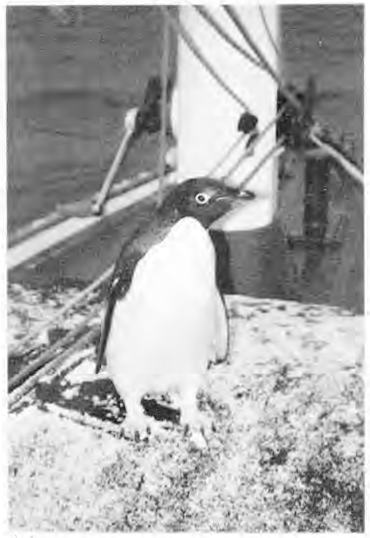
On 29 December, we shifted berth to Ellefsen Harbour (60°44’S, 45°06’W), passing through the very narrow channel separating the two harbours. Here there were more penguins and we saw a couple of leopard seals lying on some grounded bergs. We had a rude awakening in the small hours of the morning with a terrific clattering on the upturned dinghy above our heads. Annie braved the snow to see what was going on and discovered an Ad´elie penguin standing there. We guessed that it had been chased by a leopard seal and leapt out of the water straight onto the dinghy — it is not often that we have a penguin on the foredeck.
The next stop was Scotia Bay (60°44’S, 44°42’W) on Laurie Island. The Scottish National Antarctic Expedition wintered here in 1903 and then handed over the base to the Argentine Meteorological Office, who continued the work. It is the oldest, continuously manned base in the Antarctic. We tacked slowly up the bay in a very light breeze and although we declined the offer of a tow from an inflatable which appeared from nowhere, we eventu ally gave in and motored the rest of the way when we noticed a small group of people on the beach, who looked as though they were a welcoming com mittee and must have been getting rather cold. We anchored off the shingle beach and set the anchor using the engine. On rowing ashore, we were met by the officers (the station is run by the Navy) and were shown straight to the mess, where lunch was awaiting us. Fabian Guidice, the Base Comman der, and another officer spoke good English to me, while Annie exercised her Spanish well beyond its limits.
After lunch we were shown around the base and then wandered around the shingle spit on which the Orcades base is built. It joins the two halves of the island together, but it was impossible to go far – there was a steep cliff to the west and a glacier to the east and by the time we had seen the remains of Bruce’s stone hut, we had exhausted the possibilities. That night, there was a birthday party for the cook and they insisted that we join in. It was a jolly affair and the morale on the base was obviously good. It was interesting to compare the Argentine and the British bases, for although both were funded by governments wishing to maintain a presence in the Antarctic (apparently the BAS budget doubled after the Falklands Conflict), the Argentines made only a token gesture towards science, whereas BAS appears to be doing worthwhile research.
We went ashore again after lunch on New Year’s Eve. The weather had deteriorated and the barometer was falling and as it did not seem a very secure anchorage, we felt that we ought to leave. Fabian was a little upset that we had not gone ashore for lunch, in fact we had received no invitation but they had just assumed that we would eat with them. We explained that we ought to leave and they were disappointed that we would not be there to share their New Year’s Eve asado barbecue. As no-one had yet been aboard Badger, we suggested to Fabian that he bring some people out for a farewell whisky.
“Yes, of course, but first come with us.” We went into one of the large sheds and were shown into a locked storeroom.
“What do you need? Please, help yourselves.” There was every variety of tinned food, beer, wine and spirits. We did not need anything and we could hardly take any of their store of luxuries which they would need over the winter. They insisted, however, and then started filling a box with olive oil, fish, mussels, a case of beer, a dozen bottles of wine, brandy and liqueur. Their hospitality was overwhelming.
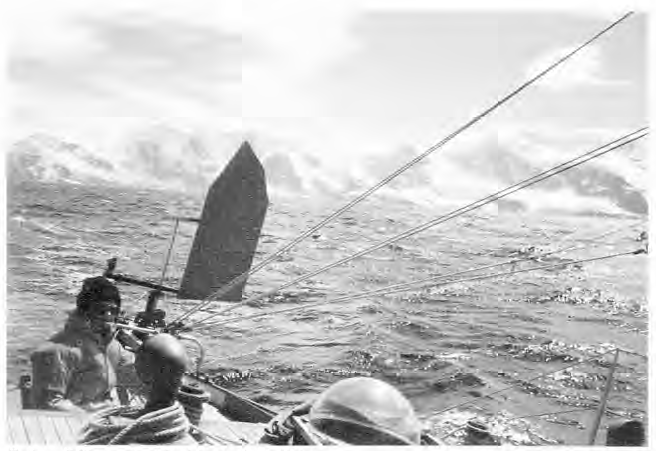
We rowed out to Badger and entertained them on board. As they left, the first snow squall came through. The true wind was now south-west, but it was hooking in to the bay from the south-east. The visibility in the squalls was almost zero and it seemed safer to stay put. In order to clear the icebergs around Laurie Island by dark, we had to leave by 1930 and just as we had given up any hope of clearing out, a particularly vicious squall started Badger dragging. We now had no choice but to leave. Barely holding our own in the gusts and inching forward in the lulls, we managed to motor out of the inner bay, and then sailed past the outer islands, dodging the growlers around each grounded berg. We had to crack on in the rising gale to get clear before it went dark and there were four hours of tense sailing in the poor visibility. The snow showers died away, but it was just about dark when we cleared the last of the icebergs and were in the open sea. Annie wished me a Happy New Year, rather sarcastically, and went below to turn in. I set up the self-steering and retreated from the cockpit to keep a lookout from under the pram hood with a clear view forward and the hood turned to shelter me from the ice-cold gale. We ran on under bare poles towards South Georgia.
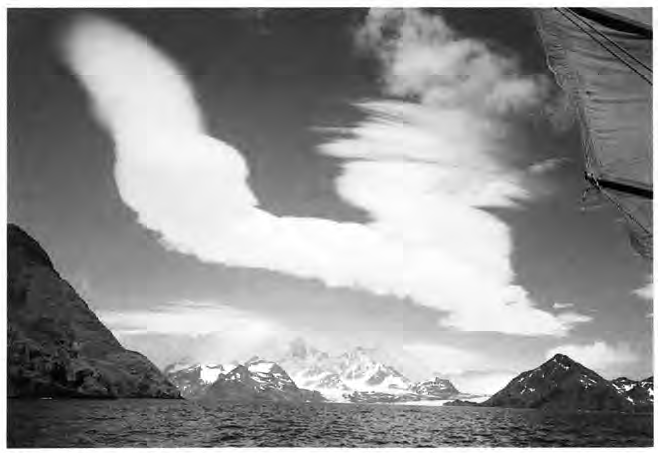
The rest of the passage across the Scotia Sea was uneventful. There was generally a fair breeze, but it was often overcast with fog and drizzle. The overcast sky prevented sights for two days before our landfall, but the DR proved good enough to find South Georgia — we had a fair-sized target to aim at. Cape Disappointment, at the south end, was sighted on Twelfth Night, but shordy afterwards the breeze switched round to the east and we had to tack up to the island. We nearly made it to anchor that night, but at 2130 it became too dark in the fog and drizzle to continue. We hove-to on the offshore tack and sailed back as soon as it became light, anchoring at 0540 in Larsen Harbour (54°50’S, 36°01’W) a dark, brooding fjord. It was well sheltered from the southeasterly gale which brought heavy snow and we were thankful to be at anchor.
As soon as it cleared, we sailed up to King Edward Cove, halfway up the east coast and the administrative centre for the island. We tied up alongside the whale catcher, Petrel, at Grytviken (54°16’S, 36°30’W), the disused whaling station in King Edward Cove. There is now an interesting whaling museum in the old Manager’s Villa and a losing batde is being fought to try and preserve what is left of the station, with weather and vandalism having taken their toll. Ten days were spent here, catching up with various jobs. Annie had the pleasure of washing the clothes in an ice-cold stream, but there was the guano shed next door, to hang it up to dry. Meanwhile, I repaired the broken batten and took the opportunity of a large concrete floor to cut-out and start sewing a new suit of sails. There was also a bit of a social whirl with the people living at King Edward Point.
On 18 January, we set off again to see as much of the island as we could and had the rather ambitious plan of circumnavigating. At 54°S South Georgia is outside the Antarctic but within the Antarctic Convergence, a band of cold water surrounding Antarctica. This accounts for its extreme climate and for the fact that over half the island is covered in ice with many glaciers reaching down to the sea.
Sailing up Cumberland West Bay we had a lot of ice drifting toward us from the Neumayer Glacier. At first it looked impenetrable but new leads opened up all the time and we were soon anchored in Carlita Bay (54°14’S, 36°39’W). We climbed the hill to get a good view of the glacier with the Three Brothers rising to well over 6,000 feet. Below us, Badger was being nudged by several growlers, so it was time to move on.
The next bay north is Stromness and there are three more whaling sta tions here. We visited Husvik, Stromness and Leith. They are full of in terest as industrial archaeology sites but we found them depressing. Their dilapidated state makes them an effective monument to human greed and destructiveness.
We cruised north up the coast, calling at each anchorage we could find. The weather was setded with generally bright sunshine, but occasionally there was fog and we had hardly any wind. Once we had left Stromness Bay we experienced our first real encounters with fur seals, the Southern Ocean equivalent of mosquitoes. I am not very brave when it comes to facing ferocious dogs (any dogs for that matter, says Annie) and snarling fur seals, with which the beaches are full, seem remarkably similar. The fur seals have made a surprising recovery since they were all but wiped out by the sealers nearly 200 years ago. It is estimated that they are back to their original number, no doubt because there is an abundance of krill since the great whales were slaughtered. Our first trips ashore to face the fur seals were nervous affairs, but armed with a ‘bodger’ each (in our case, a six foot bamboo) we gained confidence and they became far less traumatic as time went on.
One of the highlights of the cruise was to see the Wandering albatross on their nests. We had seen many of these graceful flyers out at sea, but to climb up the hill on Albatross Island (54°01’S, 37°20’W) and stand close to one sitting quietly on its nest was quite a thrill. Most of the islands in the Bay of Islands have albatross nests and the birds show up clearly as white blobs against the tussac, even from a few miles away.
The weather seemed to be breaking as we sailed on from the Bay of Islands with a fresh easterly behind us. We anchored for lunch in Barber Cove (54°00’S, 37°40’W), Right Whale Bay and then sailed on for Elsehul (54°01’S, 37°58’W) at the north-west end of the island. Just as we were making our approach the first gust hit us with far too much sail up and An nie hung on to the tiller with both hands as we tore through the water. We dared not round up, as the Stina Rocks were close to port. They were soon past and we reefed right down before sailing into the inner bay. Williwaws were coming from the east and lifting off the surface of the water. It seemed better to anchor at the east side of the bay, but that was a mistake. We dropped the 65 lb Luke anchor just outside the kelp line and between gusts set out the 20 kg Bruce, the anchors forming a ‘V’ from the steep hillside to the east of us. Williwaws attacked us all night, but we were not dragging and all was well.
At 0900 the next day, the wind shifted to the north and really started to blow. The strength in the gusts was incredible and it was hard to believe that the anchors could hold. The Luke was doing all the work, the Bruce being now on our starboard beam, so we started the engine and got out the 35 lb CQR, with its chain and rope from down below This had to be done between the gusts because it was impossible to do anything but crouch on deck as a wall of spray, masthead high, swept over us as the squalls quickly succeeded one another. In a lull, we motored out to port and dropped the CQR, veering all the cable that we could. By the time this was done, a large swell was coming into the bay. We rode over it, but it broke astern a cable away against a rock face, the spray there being carried high into the air above the cliffs. We kept the engine running to give us a slight chance if the anchors should drag or the cable part. Annie packed a couple of bags with survival gear. We had done all that we could and now had to wait, constandy checking transits ashore, both of us feeling extremely frightened. By the time that I got round to thinking that we really should take a photograph of the williwaws, the worst was over and it even seemed possible that we might survive.
The swell continued to roll in, bringing with it rafts of kelp, which wrapped around our anchor cables. Fortunately it had been a short blow and by 1600 the wind had dropped sufficiently for us to move over to the west side of the bay to escape the swell. Firstly, however, I had to clear the kelp away from the three anchors, which took four hours. Then the Luke, which had done all the work and never shifted, seemed to be immovably stuck in the bottom. I eventually broke it out using the swell, with the chain up and down, but this resulted in the chain stretching slighdy. We then shifted berth.
We had now seen the worst side of South Georgia, but apparently such conditions are not uncommon. It was one of those occasions when the word ‘travel’ more resembled its roots as ‘travail’, as in its old sense of ‘torment’. Annie was for giving up our circumnavigation and scuttling back to Grytviken but I wanted to carry on with the plan, after all we had survived the experience. Annie agreed, but was a bundle of nerves for the rest of the cruise, watching the barometer like a hawk.
After passing through Bird Sound we called briefly at Bird Island and sailed for Undine Harbour (54°02’S, 37°58’W), our first anchorage on the south-west coast. This coast is a lee shore to the prevailing wind and there are few good harbours — the Admiralty Pilot describes it as ‘rarely visited’. That first day from Undine, we looked in at several anchorages and in the evening approached Cheapman Bay (54°09’S, 37°33’W). Well out into the bay, a thick line of kelp marks the terminal moraine. From Gerry Clark’s book ‘The Totorore Voyage’ we knew that it was possible to pass over it and as the kelp seemed to be thinner to the north-east of a drying rock, we motored slowly up to the moraine and found just enough water to get through. Once inside, we anchored off a second moraine in front of a steep glacier face. It had rather a brooding atmosphere with low cloud hiding the high mountains around us. We were awoken a couple of times in the night as pieces of ice crashed from the glacier into the lagoon but fortunately the shallow moraine prevented all but small bits from drifting on to us. In the morning we recrossed the moraine, after passing through a small breaker just inside the kelp.
Once out, we sailed north of the McNeish Islands and entered King Haakon Bay. It was here that Sir Ernest Shackleton landed after his desperate voyage from Elephant Island in the 22 foot James Caird. We passed Peggotty Bluff and anchored in the lee of the Vincent Islands (54°09’S, 37°16’W), tiny tussac-covered islets near the head of the bay. After lunch, we beat slowly out of the bay. We had hoped to find an anchorage for the night in Queen Maud Bay but there was nothing encouraging. The barometer was falling slightly and it seemed prudent to head offshore. We just managed to clear the Semla Reef off Cape Nunez before dark.
The original plan to jog along overnight and to anchor off Annenkov Island the next day was changed when the barometer continued to drop. Annie was on watch and decided to press on and try and outrun the next depression. We raced on through the dark, giving Annenkov Island a wide berth as the breeze increased. Dawn revealed the jagged peaks of the Salvesen range at the south end of South Georgia, the snowfields glowing pinkly. As Badger approached Cape Disappointment at 0900, the gale arrived and rather startling williwaws were seen ahead, whipping up the water off the Cape. I was in the cockpit steering as we passed between First Island and Brode Island. The wind was a steady F10 and, once past the islands, I pulled down the scrap of mainsail and we ran on under bare poles at 5 knots, with the main boom squared off.
We had made it back to the lee of South Georgia but our problems were not over yet. The wind suddenly switched off and in the wicked jobble, the mainsail bundle crashed over, snagged around the miniature ‘samson’ post on the cockpit backrest and ripped the whole thing off! Fortunately I caught it before it was thrown overboard and shouted to an astonished Annie, who quickly took it below and dogged the hatch again. Barely had I raised the top of the sail when the wind was back at full strength. So it went on until we were at the mouth of Drygalski Fjord. We sailed on through Cooper Sound and eventually anchored in Wirik Bay (54°45’S, 35°51’W) at 1800. Annie heaved a sigh of relief to be back on the ‘safe’ side of South Georgia and I must admit to feeling a release of tension myself.
We pottered back up to Grytviken, visiting quite a few more anchorages in the next ten days, and arrived there on 17 February. South Georgia is a spectacular island, with grand scenery and much wildlife, but it is not a sailor’s paradise. We found the breeze to be either very light or far too strong, difficult but rewarding cruising. No anchorage is entirely sheltered from the extremes of the weather so one is always a little on edge.
Annie renewed her acquaintance with the ice-cold stream and I glued the backrest back in place. We were getting ready for the long passage to Cape Town. Tim and Pauline Carr returned from their summer cruise in Curlew and it was good to meet them again and hear their stories of South Georgia. They have spent the past three years here, making a cruise each summer and winter, a remarkable feat in a 28 foot, engineless yacht. Also in Grytviken was the American yacht Shingebiss II, with Larry and Maxine Bailey and their crew, Gary, aboard, flying the CCA burgee. We had first met them in the Falkland Islands and they, too, were getting ready to sail, but towards the Mediterranean.
We ghosted out of Grytviken on the last day of February and both were aware that we had a stormy stretch of ocean ahead of us. A course for Tristan de Cunha was set and we had a rough sea most of the way there but, amazingly, no gales. We sighted Inaccessible Island on 13 March and anchored in its lee the following morning after spending most of the night hove-to in a south-westerly F7. Two red, ships’ lifeboats were fishing off the shore and one of them gave us several crayfish. They were from the ship Tristania which spends several months each year fishing around the Tristan group. The surf breaking on the shingle beach prevented a landing but it was very pleasant to be at anchor.
The crayfish could not have come at a better time and the skipper’s forty-fifth birthday was celebrated a day early. At 2030 that evening the north-west wind shifted back to the south-west and we lost all our shelter so carried on under reduced canvas towards Tristan de Cunha, 40 miles away. We came up with the island after breakfast and sailed along the coast, past the settlement at Edinburgh. The left-over sea from the previous strong north-westerly made anchoring seem risky and many people came out into the streets to watch us as we reluctantly continued past. We wondered whether to anchor in the lee of the island and await better weather but the year was getting on and we still had a long way to go to South Africa and wanted to see Gough Island first.
We headed south-east towards Gough Island (40°21’S, 9°52’W) unsure if we were wasting our time as a landing seemed unlikely. Three days later we sighted Gough after a comfortable sail in light westerly winds. We came up with the island just after dark but failed to find an anchorage in the bright moonlight so headed offshore for the night. At dawn, a huge school of dolphins accompanied us into Transvaal Bay where the South Africans have a meteorological station, leased from the British Government.
After anchoring, we rowed to the crane on the cliff, as there seemed nowhere to land. Three young men in wet-suits were lowered by the crane and after the initial pleasantries we were asked if we needed medical attention. No, we were fine. Yes, they insisted, but were we sure?
“We can only allow people ashore if they require medical assistance.” “Aha!” said Annie, “I do have tennis elbow”, from which she had been suffering since the previous July and instantly, we and the dinghy were hoisted ashore by the crane.
Seven young men man the station and they spend a full year here on this lonely island. Their only physical reminder of the outside world is the weekly Johannesburg to Rio aeroplane that makes its course change over the island. Even this glimpse is usually denied them by the generally poor weather. We, however, visited on a glorious day and were taken for a walk to see yellow-nosed albatross chicks on their nests. After lunch, five of the men swam out to Badger for a sail up the island to the Glen. Back at Transvaal Bay we dropped them off and took some mail aboard. It was tempting to stay at anchor overnight and sail around the island the next day but the anchorage had a rocky bottom and we did not feel safe, so decided to press on. It was only then that we remembered that the medic had forgotten to look at Annie’s elbow.
We felt that we could not get away with a passage through the Southern Ocean without a gale, but the rest of the trip was made in generally light airs. The first ten days brought mostly easterly headwinds and, after a spell of light westerlies, we made our final approach to the Cape with a south-easterly breeze.
We sailed into the harbour on 6 April and as we did so, a couple on the end of the breakwater waved and shouted, “Welcome to Cape Town, Badger !”.