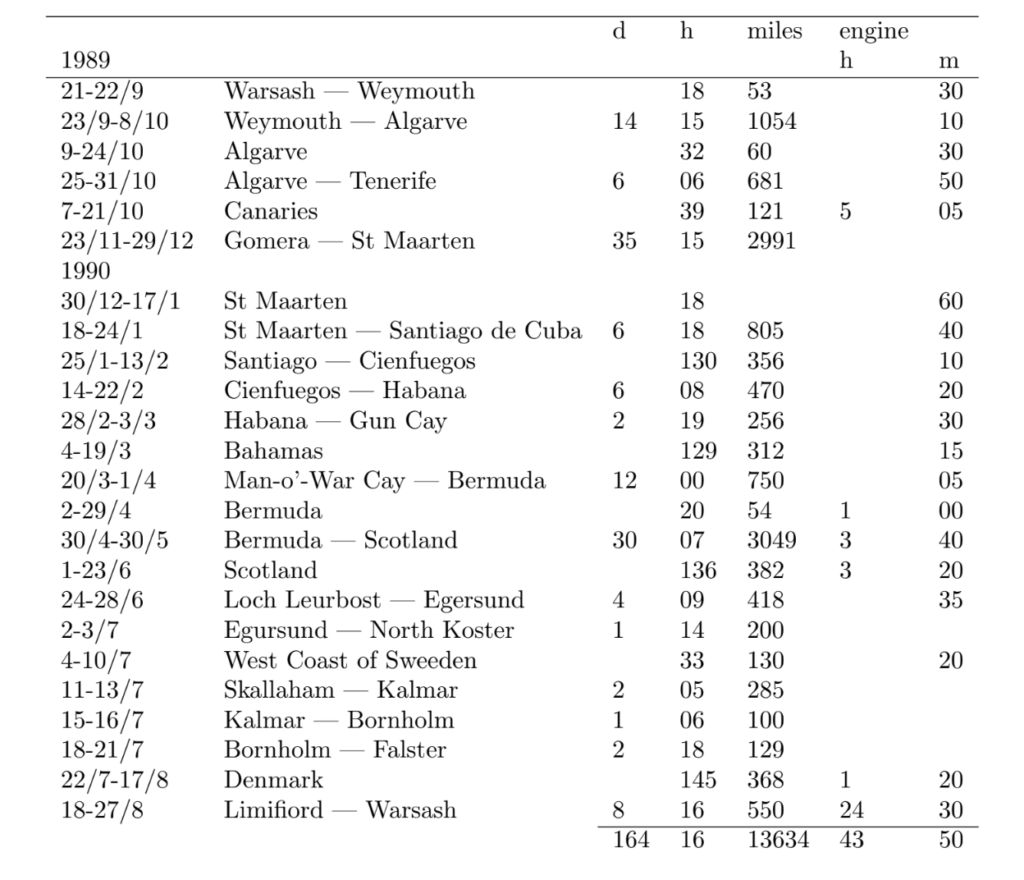
Pete and Annie Hill sailed Badger from the Solent to the Caribbean via the Algarve and the Azores, re-crossing the Atlantic to visit family in Scotland and thence to Norway, Sweden and Denmark. The return journey to Warsash nonstop from Limfiord was marred by a F 9 gale in the German Bight during which Annie hurt her back. In eleven months they covered 13,634 miles. This article concentrates on the Cuban section of their marvellous cruise.
In an ideal world, summers should be spent cruising in the high latitudes where the days are long, and winters in the low latitudes where the nights are warm. In between, it ought to be possible to have some good long passages. Our plan for last winter was to visit Cuba and then to return to the Baltic for a summer cruise in the Gulf of Bothnia.
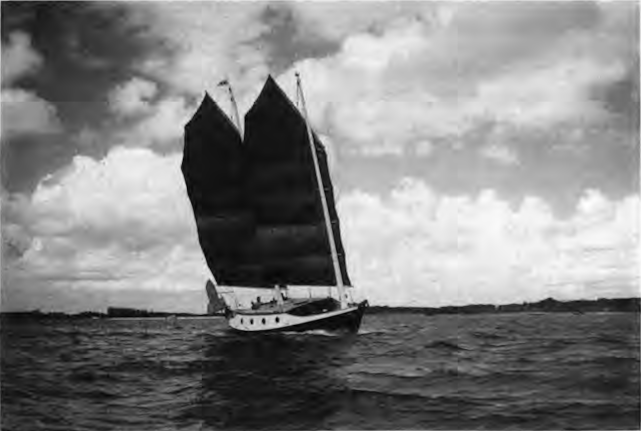
Our home for the past eight years has been Badger, a 34 ft double-ended dory, designed by Jay Benford. The hull is cold-moulded plywood covered with glass cloth. The decks, however, are sheathed in teak to save us the trouble of painting them. Slung beneath her flat bottom is a Collins tandem keel, giving a draught of 4 ft 6 in, and a skeg-mounted rudder. Badger is rigged as a Junk schooner, surely the finest shorthanded rig. While Badger is not everyone’s ideal ‘proper yacht’, we are very fond of her and she has taken us wherever we have wanted to go with a fair measure of comfort and alacrity. Best of all, Badger is fun to sail.
Before we left England, Annie had been trying for over five months to get a visa application form from the Cuban Embassy. They seemed helpful over the telephone, but never got around to putting one in the post. A last desperate attempt before we set sail from the Solent after the Beaulieu Meet elicited the information that they thought we might be able to obtain a visa when we got there. Our arrival in Cuba was, therefore, tinged with some anxiety.
We reduced sail as we approached the Cuban coast in the small hours of 24 January, to time our arrival at Santiago with daylight. We had no sooner sailed into the entrance than a gunboat appeared to meet us and told us to lower our sails and follow him under power. We were delayed while I tried frantically to start the engine after flooding it, but eventually got it going. Badger’s engine is a small petrol saildrive of 7hp, which gives a cruising speed of 4 knots if there is not too much wind against us. This, however, was not sufficient to keep up with the gunboat, which seemed to have a minimum speed of about 8 knots. They would charge ahead and then wait for us to catch up and charge ahead again. The perfectly landlocked harbour was full of ships at anchor and we motored past a large oil refinery and a cement works. The gunboat led us to a dock near the town centre and here we tied up to await the officials.
There were several dockside loafers munching fruit next to a small stack of fruit boxes. One of them walked over and offered us a couple of tangerines. They were delicious — juicy and just out of refrigerated storage. On seeing our delight at this offering he returned with a handful of chilled oranges, then some more tangerines, and finally a pineapple. This bounty came to an end when a launch arrived and loaded up the boxes of fruit to take them to a ship in the harbour. Then the officials started to arrive and crowded below to spend a rather hot hour filling in endless forms. Everyone was good humoured and friendly. A little man appeared with a camera to take pictures of us and odd corners of the cabin, to what purpose we never found out.
The officials were just about to depart when our ship’s stamp, a rather frivolous affair, was discovered — all the forms had to come out again to have our stamp on. The Port Captain had brought two ratings aboard and Badger was given a very thorough search from end to end. We were then directed to lie alongside an American yacht on the other side of the jetty. This was a big steel ketch, showing her age somewhat; painted on canvas dodgers were the slogans ‘Viva Cuba!’ ‘Viva Fidel!’. Obviously they were unsure of their reception, but I think that the slogans merely baffled the officials and they seemed a little unsure of how to take the ‘laid-back’ crew.
The following morning our passports were returned, together with our visas, which were issued for one month at a cost of US $10 each and renewable. The immigration official brought with him a young man from Cubatour — the Cuban travel agency. Hippolito spoke excellent English and was at our service to arrange hotel accommodation, chauffeured cars, a diving course or deep-sea fishing — whatever we wished to help us enjoy our holiday. His face fell when he heard how little money we had and it took about twenty minutes to explain to him what it was that we wanted to do. A cruising yacht was a completely unknown quantity, but when he finally understood that we had not come for a luxury holiday, but to see something of his country and how the people lived, he became very enthusiastic.
The next problem was to get permission to cruise the south coast: that was impossible, we could only go to official ports as the coastline was dangerous to navigate. Clearly the authorities did not want us to sail along the coast unsupervised. Tentatively he suggested a visit to the Archipelago de los Jardines de la Reina, a large area of coral cays off the south coast. As this was exactly what we wished to do, we agreed to this and Hippolito then set to work to get the necessary permission. Meanwhile we explored Santiago, a rather rundown city with many of the buildings in need of repair. It was also hot and dirty. We changed most of our dollars and went in search of fresh food. The market only had malanga roots, which we felt we could live without. We found out that virtually all the food was rationed, but by wandering around and looking into the small corner shops in the backstreets we managed to buy eggs, tomatoes and oranges, sold ‘venta libra’. The easy way to buy food in Cuba is to go to the ships’ chandler, where excellent quality food was available, to be paid for in foreign currency. We called in at the one in Santiago and even with our modest order of $5 worth we were treated as valued customers.
We had given Hippolito an itinerary of our intended visit to the cays and this had been approved, so tiring of our dirty and noisy berth in town, we went to get clearance from the Port Captain. After a four hour wait the officials arrived, filled in their forms and had a quick inspection for stowaways. We left Santiago late in the afternoon, escorted out by a small launch.
The winds along the south coast would often be light, although generally from the east. The land mass of Cuba tended to block the full force of the Trades, but it also formed a barrier against the ‘northers’ which so affect the weather of the Bahamas during the winter months. We had a slow passage to Cayo Anclitas, taking four days to cover the 215 miles. There now followed a week in paradise as we explored an endless number of small sandy cays, clearly shown on excellent Admiralty charts. We enjoyed cruising in sheltered waters where gentle breezes blew until lunchtime. In the mornings we sailed, then anchored for lunch and in the heat of the windless afternoons went snorkelling among the coral. Under the coral heads were crayfish by the score, so every evening we dined on fresh lobster, washed down with some of our specially imported Spanish wine. The only sign of civilisation was a few fishing boats in the distance.
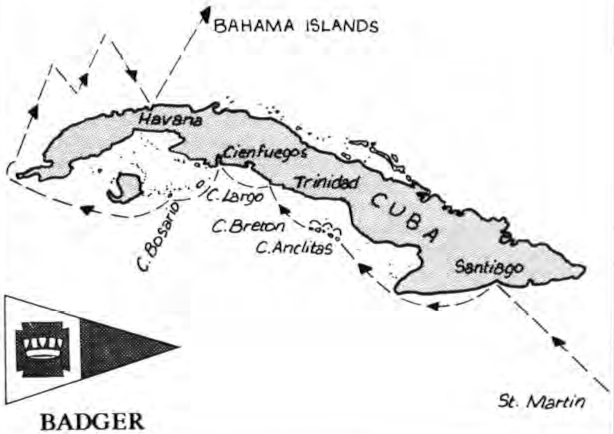
We reluctantly left Cayo Breton on the evening of 8 February to sail overnight to Puerto Casilda. This is a small sugar port built on low land and surrounded by mangrove swamps. Five miles away, set on a hill, is the old colonial town of Trinidade. The town is well preserved, with beautiful old buildings, cobbled streets and shady squares, whilst the lack of private cars makes walking the streets a pleasure.
Fifty miles and an overnight sail brought us to Cienfuegos, another landlocked harbour. We sailed in and were directed to the ‘marina’ — actually a crumbling concrete dock. After dealing with the paperwork we went to enquire about the cost of berthing. For Badger it would be $17 per day. This was quite out of the question, but after some discussion we found that we could anchor on the other side of the bay. It was a long row into town but otherwise a pleasant anchorage. Cienfuegos, like Santiago, was a busy, noisy town, but memorable was the Teatro Tomas Terry, a Victorian opera house where Caruso had sung. It was in excellent and original condition, with frescoes on the walls and ceiling and tiered balconies. The interior was being given a spring clean and scenery was being set up in readiness for a performance of Giselle by the Cuban Ballet.
From Cienfuegos we had a long haul round to Habana. We decided to anchor for the night off Cayo del Rosario, a deserted cay to the east of the Isle of Pines. The following morning Annie wasn’t feeling well, so we stayed the day at anchor. At 2300 that night we were woken up by a small patrol boat coming alongside. On board was an interpreter who spoke excellent American English and he explained that they wanted us to follow them to Cayo Largo — a holiday resort some sixteen miles away. I didn’t like the thought of following them over shallow water in the pitch dark, but fortunately our slow speed and the thought of escorting us for four hours eventually put them off the idea and, seeing that our papers were in order, they left us in peace. A fisherman had obviously reported us and so a boat had been sent to investigate. The following morning Annie was much better and we carried on.
We had a good run down to Cabo San Antonio at Cuba’s western end and then turned the corner for the beat eastward to Habana. By standing out to the north we hoped to get more of the embryo Gulf Stream with us. It took three and a half days to beat the 190 miles from Cabo San Antonio to Habana. Whilst we were on passage, the USCG vessel Evergreen sent a boat over to check on us, again in international waters. They seemed content to copy details of our previous boarding, which had taken place between St Maarten and Cuba, but tailed us for three hours afterwards, doubtless while checking the details.
Another incident on this passage occurred at 0500. Annie had just handed over the watch to me, saying that there was a small motorboat slowly catching up astern. I was keeping an eye on him from the hatch when suddenly, with a roar of engines, he flew past us close to starboard at about 40 knots. The small motorboat turned out to be a hydrofoil, which then repeatedly buzzed us at high speed before just a suddenly sheering off and speeding away. The US Navy has hydrofoil patrol boats — but whoever it was, they certainly gave us a fright.
We arrived off Habana late in the afternoon and set about finding the marina — anchoring elsewhere being prohibited. We had no large-scale chart of the area, but knew that the marina was to the west, some miles from the city. Eight miles to the east of Habana the marina’s position was indicated by the sight of a large ‘Gin Palace’, and just before dusk we motored through the cut in the coral. The channel, which is marked by buoys and leading marks ashore, is on a course of 140° and we found a depth of 15 ft at low water. The Marina Hemingway has been created from a pre-revolution Fort Lauderdale-type development.
The following morning we asked directions from the French ketch Fleur de Passion for the journey into Habana. They told us which buses to catch, but added ‘The journey, it is — how do you say — ’ell! You only travel to Habana once’. After two bus changes we found ourselves in old Habana and wondered what all the fuss was about. Late in the afternoon a norther blew in with heavy rain and a sharp drop in temperature. The journey back from Habana was indeed ‘’ell’. Cold and soaked through, we huddled for hours with the others in the bus queues. One bus broke down, but that was obviously so common an occurrence that no-one flickered an eyelid. That was followed by missing our stop and ending up at a bus depot in the middle of nowhere. After five hours to travel the eight miles we arrived back at Badger to find that rain had poured in our open scuttles — over the bookshelf.
The following morning revealed a solid line of breakers across the entrance and a steel Polish yacht stranded on the inner reef. She was pulled off later that morning, but several yachts have been lost trying to enter the marina in strong northerly winds. We had to stay four days longer than planned until the channel was passable, but ‘El Jefe’ waived the extra marina charges. In the meantime we found out that the ‘Gin Palace’ was the 60m motor yacht El Bravo, registered in Panama. An air of mystery surrounded her. She had a crew of thirteen Poles and her owner was supposed to be a Swiss banker, but rumour had it that she was General Noriega’s yacht, being kept in Habana out of American hands.
We came away from Cuba after five weeks with some vivid impressions. Fidel seemed loved by all the people, and as long as he is leading the Revolution seems to be in no danger. The changes occurring in the USSR must mean an end to the heavy subsidies Cuba has enjoyed, and consequently large economic problems lie ahead. While the people enjoy few luxuries compared to the West, they all appear to be well fed and the standards of education and health care are very high. It is unfair to compare the standard of living in Cuba with that in Florida, ninety miles away — in comparison to her neighbours in Hispaniola and Jamaica, Fidel’s Cuba does very well.