

When I joined Oryx, I did not realise that she would be such a head turner. Everywhere we go, we have numerous visitors who want to know about the boat and its unusual aero junk rig. Even Polynesian TV accosted us, wanting to know more and filming us as we were anchoring on our arrival at Raivavae, the Austral Islands. They came back a few days later to make a whole feature about it.
We met a few boats which seemed to be set for the war; a steel hull, thick and heavy stainless steel all over their decks, pulpit, pushpit, rigging – you name it, they ‘steeled’ it from the hull to the top of the mast. Only sails were not made of steel. They seemed to be like floating battleships or tanks ready for combat. I wondered what those ‘battleship’ owners were thinking when they visited Oryx and saw thin plywood bulkheads, a springy cockpit sole, a “flimsy” looking tiller arrangement, rigging held by numerous strings full of knots, peculiar sails, plus no traces of stainless steel anywhere. When returning back to Oryx from one of those boat visits, I suddenly realised that I was floating on a paper boat, its rigging held by stringlets. I meant this as a compliment to Oryx and Pete for their alternative approach and way of doing things. So far, we have been doing quite well with numerous gales in our wake.
I watch Pete, with admiration and in envy, hoisting up the sails seemingly effortlessly, while for me that is still a tour de force, to say the least, especially when the wind is strong, and we are sailing downwind. I have little strength but boundless determination. After a lot of physical struggle, I manage to hoist up the sails. Every muscle in my body tenses up and joins forces in this massive effort. I push, angle and balance myself properly to get the best power-to-weight ratio so that I remain in the cockpit while the sails go up, hopefully! It is incredibly uplifting to see the top panel flutter on the top of the mast. Mission accomplished, I am exhausted but content, fulfilled and can enjoy the spectacle.
It feels like setting at large “War Horses” puppets and watching their elegant orange wishbone battens trott along in a playful dance on their way up the mast. With the wind in their bellies, they are charging along in no time, joyful and full of life. Tacking is a short excitement unleashed. The giblets flap like horses’ manes in the wind, making a lot of neighing noise accompanied by the rattling of their reins, chains, and stirrups in the rigging. Shortly afterwards, all horses’ heads are aligned, silence and peace is restored as we are sailing into the wind until the next tack when more fun is briefly released. Oryx’s tan sails come alive when lit up by golden sunlight, especially at dawn or dusk. Their colourful contrast to the environment surrounding us is outworldly. The wishbone batten shadows imprint each other on the opposing sail, creating a mesmerising kabuki show in which these friendly characters are in a world of their own. My heart feasts on this magical light performance played only for me on a vast stage of ocean expanse.
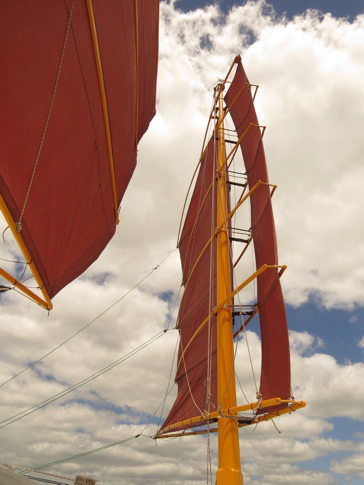
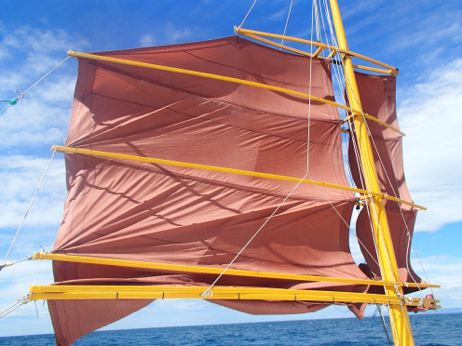
Sailing on and off a hook is something I did not know was done these days. Pete does this with confidence and ease, which I struggle to comprehend. There we are in the shallows above the reef, 0.5m of water below our keel, the wind drops, and we are heading for the rocks and shallows.
“Engine on?” I ask
“No, no – we are all right”,
he responds, showing no signs of concern or trouble. Meanwhile, I tremble, and my heart stops its beat until confidently, calmly and slowly he gets us out of it, without a twitch! On other occasions, it is a sheer joy to take part in a fast and furious escape from the anchor when it is blowing hard, but we are well semi-sheltered by the land. As we drift back, we position the stern this and that way and do things that make no sense to me yet, but we are away.
For some anchorages, I see no way out when in close quarters, we are surrounded by reefs, cliffs, and boats. Then Pete explains what is likely to happen, generally giving us two options and what to do for each. I am amazed by his skills of drifting, sailing backwards, hoisting some sail, hoisting all sails, letting sails out, pulling sails in to catch the wind, or to spill it, to get us moving in the right direction and out of the tight and narrows. Suddenly, it seems like we have many options, and there I was worried that we had to motor. So far, we never had to switch the engine on when Pete decided to sail on or off the hook.
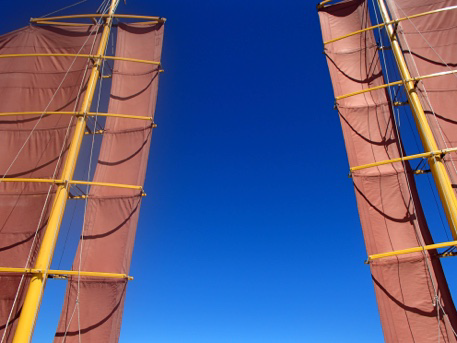
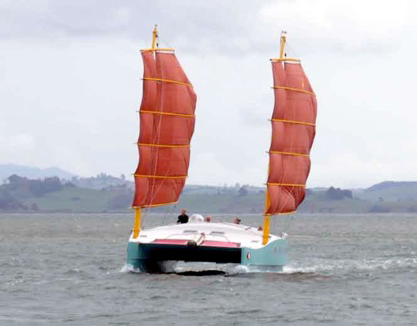
The most memorable searching for an anchoring point was when we sailed in a tightly packed anchorage in light winds. All boat owners apprehensively and attentively watched us sailing by, far too close to their boats for their liking. The little wind that there was, nearly, but fortunately only nearly, dropped, and we did not stop but carried on until the right available spot was found. Cool, seemingly unperturbed. We let both sails drop in an instant, creating a big rattle and then stopped. Everyone’s breathing could be resumed.
I place immense value on Oryx’s bridgedeck saloon when sailing offshore in bad weather, sitting comfortably inside with a view of the surrounding seas through its big oval stern window and 2 windows in each hull – combined giving 180 degrees view of the seascape around us. Magical.
Not to mention “the world in a bubble” 360 view view which enables me to look out from inside and not have to go out when it is rough, wet and cold. At anchor, we enjoy the comfort of a spacious, clean-line cockpit and its cuddy, which we appreciated even more for keeping us dry on wet, rough days and for sheltering us from the sun and heat when under long ocean passages. These are Oryx’s carriages in which we are safely and comfortably sailing along.
Oryx is for sale in Whangarei, New Zealand – advertised on the JRA website and worldwide.