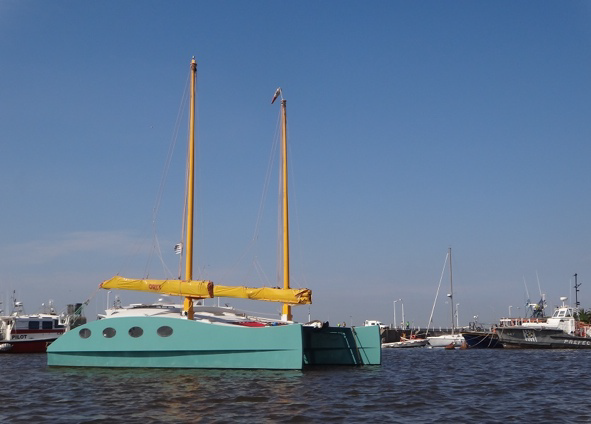
Awarded the Founder’s Cup by RCC
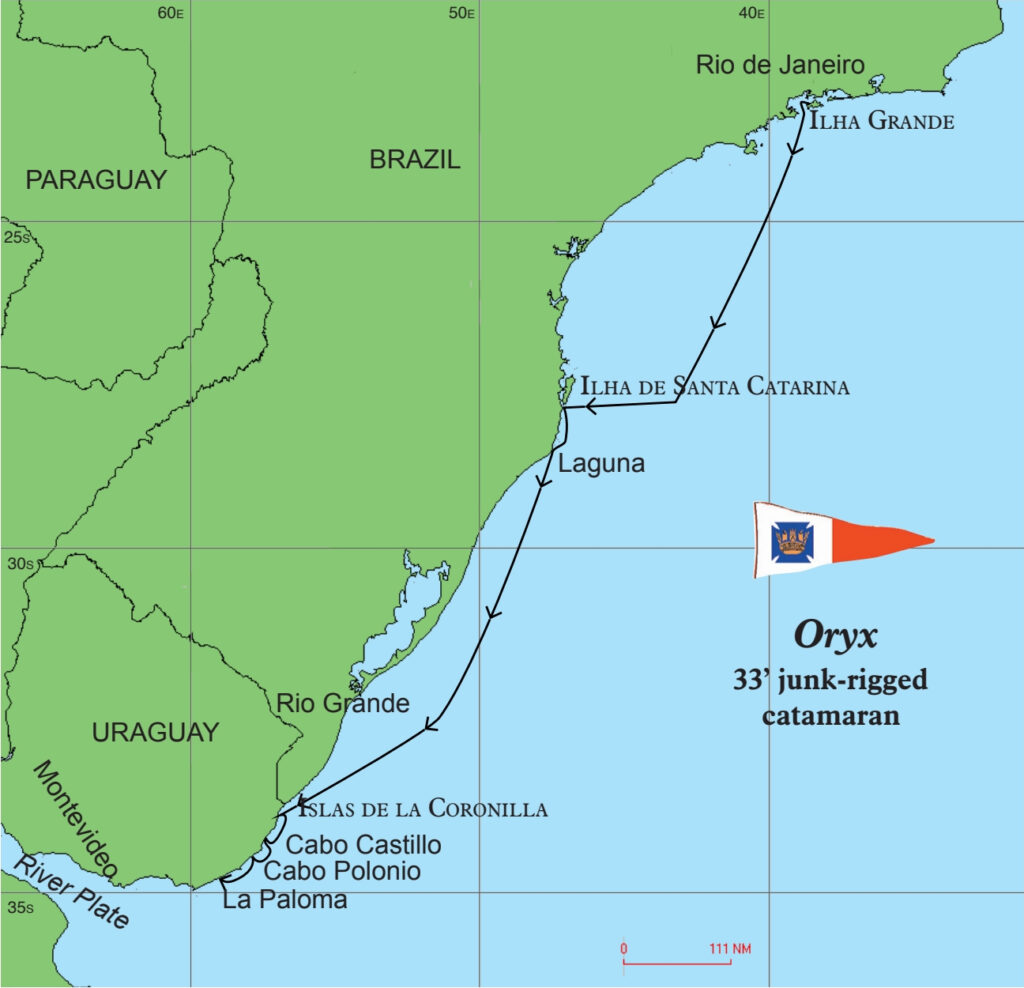
Our 180 days in Brazil were up so we cleared out of Angra dos Reis for Uruguay, 1000 miles to the south-west. Before leaving Brazil we sailed over to Enseada de Sito Forte, on Ilha Grande, where a beach bar kindly runs a hose of spring water out to a stone pier in the bay. We topped up our water and washed all the laundry before a final stroll down the beach and a sunset caiparinha.
The next morning, 2 September, we set off. While Ilha Grande is a marvellous cruising ground with umpteen islands and islets to explore, it is not a sailor’s paradise as the winds are usually light and fickle. We drifted about hopefully for an hour or so before motoring in a flat calm at the west end of the island where we found a light south-easterly. The wind veered and freshened right on the nose. It stayed there for two days, until it backed to southeast again, increasing to a good F5 before eventually settling in the north.
Oryx was sailing along at a grand pace with the wind vane keeping her bang on course until my midnight watch on the 5th, when she suddenly went off course. Going on deck revealed that the port rudder’s lower fitting had broken and the top pintle bent over at 45°. I released the two halyards of the already reefed sails and let them drop down while I dashed below to wake Carly with the news. On deck again, I saw that the rudder had broken free and was only held on by the thin self-steering lines. Leaning over the aft beam, I grabbed the tiller and held on for dear life as the rudder thrashed about in our wake. The sails had dropped, but the tops were still up enough to have us reaching at 3kts or so. I hollered to Carly, who was still below getting dressed. Coming on deck she dropped the sails and helped me to drag the rudder into the cockpit.
My first thought was just to carry on, as we still had one good rudder, but Carly, more prudently, suggested that we ought to head into the coast to do the repairs. On reflection we suspected that the cause of the failure was when we ran into a drift net some months previously off Cabo Sao Tome. To paraphrase Lady Bracknell, ‘To lose one rudder may be regarded as a misfortune, to lose both looks like carelessness.’ We were 80 miles off Ilha de Santa Catarina. I knew of a sheltered bay close to the south of it, so we got underway again with the wind on the beam and just the windward sail up, well reefed to keep our speed reasonable. We just made it into Enseada da Pinheira before the last of the light went and anchored at the north end of the bay amongst a host of mussel farms.
Here we spent a week repairing the port rudder and strengthening the starboard one too, while a fresh north wind went to waste. On Saturday 14 September we moved over to the south side, where there is a small town, and bought some fresh provisions before heading out that evening with a nice NE3. Overnight the wind died out before filling in again from the SW. We beat down the coast against a quite strong current, making poor progress. By lunchtime we had made it down to Laguna and, in the lee of the long breakwater, anchored in 6 metres with big swells from the south-east, much to the delight of the surfers inshore of us.
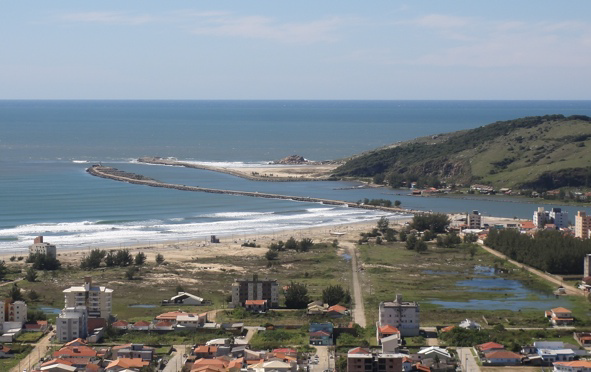
A recent innovation for us is a smartphone making it possible to get weather forecasts when near the coast. The wind was due to go to the north, but a Pampero was expected to pass along the Rio Plata about the time we would arrive there. After Laguna the only shelter was the Rio Grande, not always easy to enter, and so at first light the next morning we entered into the channel for Laguna. Big seas were just not breaking as we scuttled between the breakwaters and then sailed serenely along the calm channel. We anchored just past the car ferry before the channel turns the corner to the town. We hoped to remain unnoticed by the authorities, but breakfast was hardly over before a grey RIB came alongside. Our papers were examined and we were asked to re-anchor off the town before reporting to the Port Captain’s office. We cleared in with no problem about seeking shelter from the bad weather and spent four pleasant days there. The old town faced the large but shallow lagoon with many fine older buildings, while on the ocean side was all high rise apartments and hotels, almost deserted at this time of year.
Setting out again with a fresh northerly we sped along with impressive swells from the south-east as the wind slowly veered and eased. One day the starboard sail suddenly decided to drop down, the fitting on the yard having broken, but it was soon up again on the spare halyard. We eventually ended up sailing long and short tacks close to the beach to keep out of the adverse current as we crossed the border into Uruguay. Here, under similar conditions Joshua Slocum ran the Spray aground, which took him several days and some assistance to get off.
A few miles south of the border lie the Islas de la Coronilla, a reef of small islets, and that night we anchored in the lee of Isla Verde. Early the next morning we got under way, accompanied by several fur seals and spent much of the morning motoring in a flat calm with thick fog patches. An easterly wind sprang up in the afternoon and we sailed on to anchor off Cabo Castillo for a short while until the freshening wind forced us to seek better shelter a few miles away at Cabo Polonio. There was too much swell to land on the beach the next morning, so we sailed on to La Paloma, our first port in Uruguay, arriving there on 27 September.
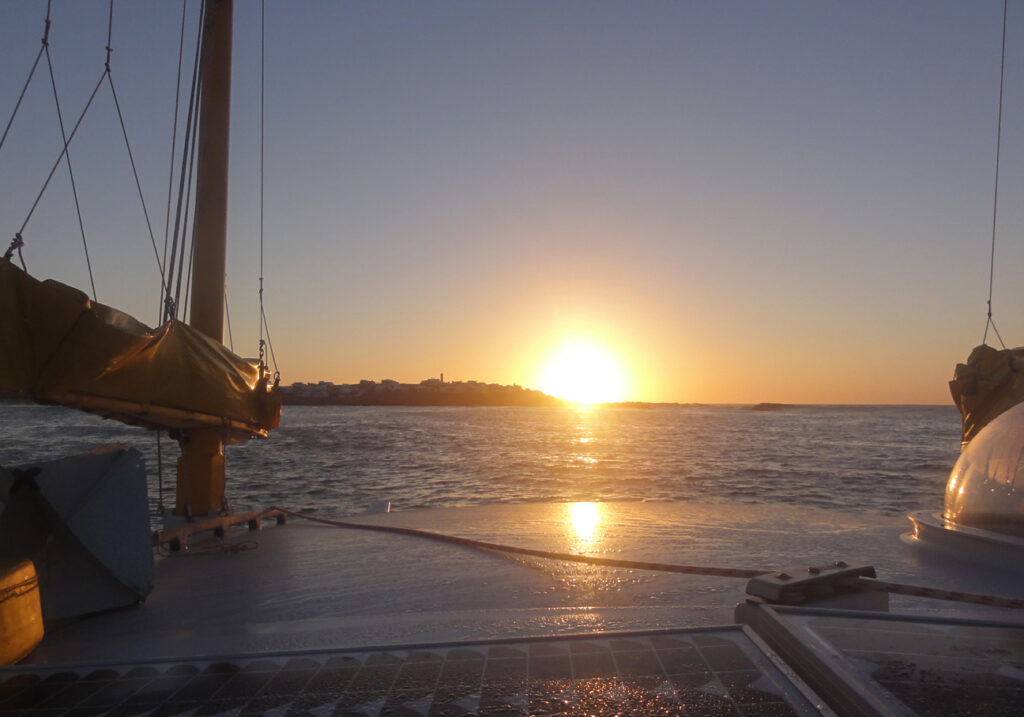
It had taken us 25 days to do the thousand and odd miles, and had us pondering the trials and tribulations of our passage, but people were still talking about the week of gale force winds that the Pampero had brought, so perhaps we had a lucky escape.